|
|
Joined: Mar 2013
Posts: 52,481
Legend
|
OP

Legend
Joined: Mar 2013
Posts: 52,481 |
We will see. The CBO scores the meat and potatoes of the plan, said it would add 1.7 trillion.
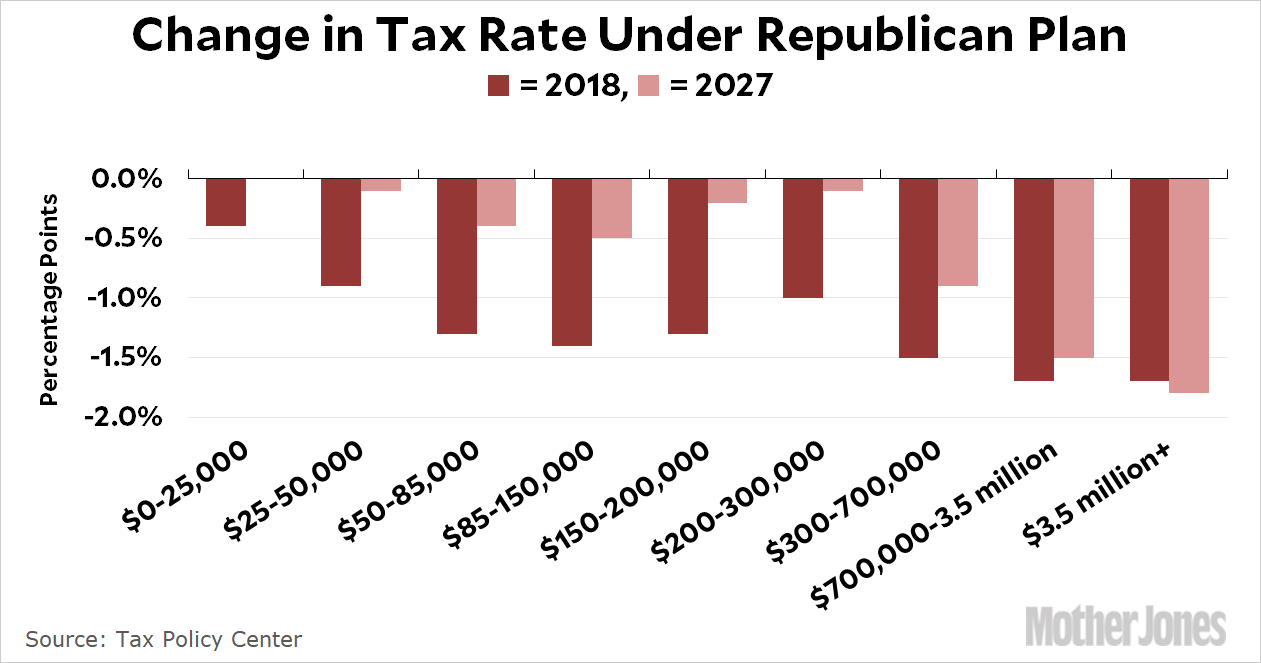
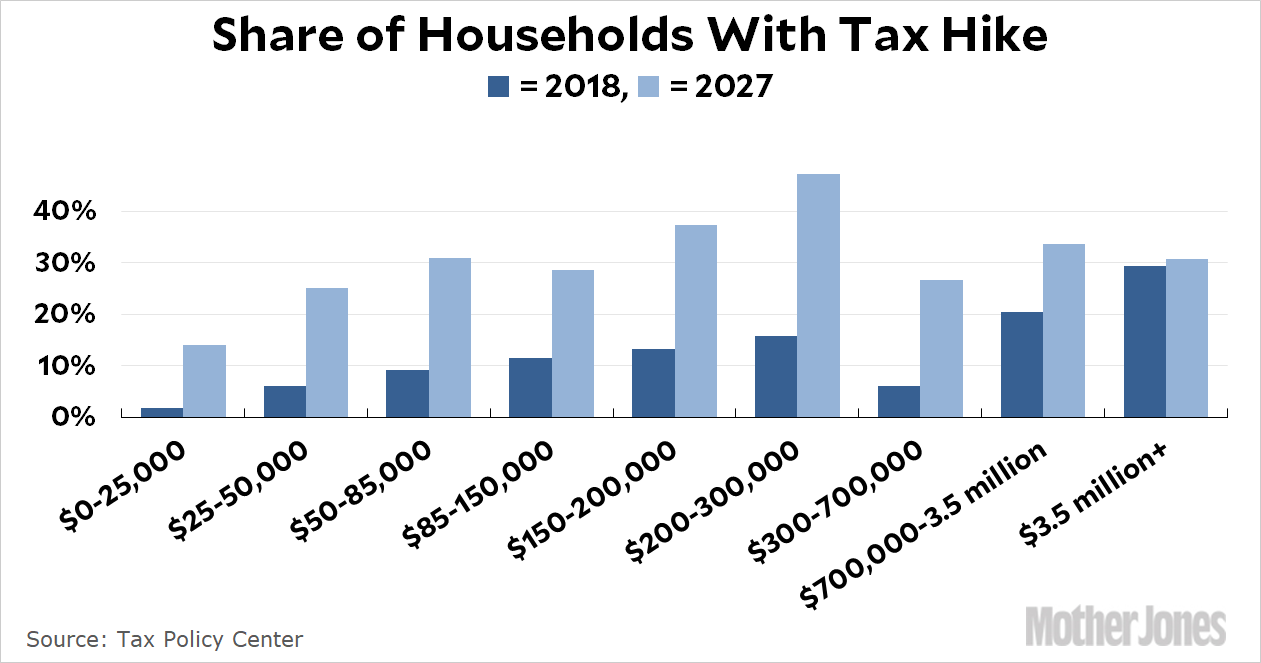
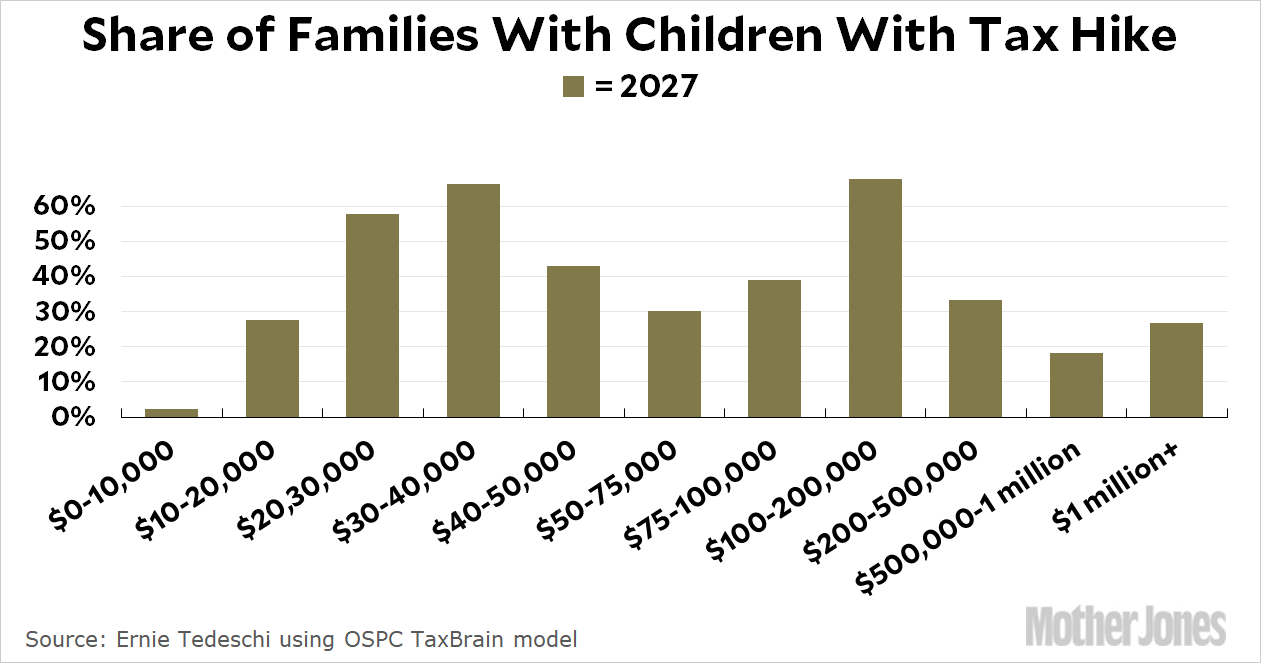
Some middle class will actually see their taxes go up, while the rich all get a cut.
Few things I’m wondering:
Will senate republicans remove their loophole anti abortion nonsense?
Will the rate be adjusted that way middle class doesn’t see a tax hike?
What are they doing with 401k contributions?
“To announce that there must be no criticism of the President, or that we are to stand by the President, right or wrong, is not only unpatriotic and servile, but is morally treasonable to the American public.”
- Theodore Roosevelt
|
|
|
|
|
Joined: Nov 2006
Posts: 3,259
Hall of Famer
|
|
Hall of Famer
Joined: Nov 2006
Posts: 3,259 |
It's also `nice` to see the GOP rail against deficit increases when one person is president and then propose to vastly increase the deficit when another person is president.
Last edited by gage; 11/09/17 12:35 AM.
#gmstrong
|
|
|
|
|
Joined: Sep 2006
Posts: 34,813
Legend
|
|
Legend
Joined: Sep 2006
Posts: 34,813 |
It's also `nice` to see the GOP rail against deficit increases when one person is president and then propose to vastly increase the deficit when another person is president. They are responsible for most of the debt! Wars and nation building are expensive work. Those bills just got kicked down the road when the GOP created them.
Last edited by OldColdDawg; 11/09/17 02:33 AM.
|
|
|
|
|
Joined: Sep 2006
Posts: 27,850
Legend
|
|
Legend
Joined: Sep 2006
Posts: 27,850 |
We will see. The CBO scores the meat and potatoes of the plan, said it would add 1.7 trillion.
Some middle class will actually see their taxes go up, while the rich all get a cut.
Few things I’m wondering:
Will senate republicans remove their loophole anti abortion nonsense?
Will the rate be adjusted that way middle class doesn’t see a tax hike?
What are they doing with 401k contributions?
Will they still want to break it off in the backside of sick folks by eliminating the medical deductions?
I AM ALWAYS RIGHT... except when I am wrong.
|
|
|
|
|
Joined: Sep 2006
Posts: 11,897
Legend
|
|
Legend
Joined: Sep 2006
Posts: 11,897 |
I've been doing my own research on the tax bill. I've been looking for unbiased discussions, and I thought that this was one where both sides were discussed fairly. It ended up being a terrible look for Cohn, though, IMO. http://www.msn.com/en-us/money/markets/g...&ocid=ientp
Blue ostriches on crack float on milkshakes between the sidewalk titans of gurglefitz. --YTown
#gmstrong
|
|
|
|
|
Joined: Sep 2006
Posts: 34,813
Legend
|
|
Legend
Joined: Sep 2006
Posts: 34,813 |
The Republican tax plan could financially devastate graduate studentsThe bill would tax tuition waivers as income by Rachel Becker@RA_Becks Nov 7, 2017, 2:36pm EST Kathleen Farley, a graduate student in biological sciences, paid $2,824 in taxes on her stipend of $25,969 last year. If President Donald Trump’s tax plan takes effect, she calculates that she’ll have to pay $5,174 — almost double what she’s paying now. The unexpected financial burden might force her to drop out of Rutgers University-Newark. “If you walk away, you have nothing,” she says. “I would have just lost four years.” Farley is one of the thousands of graduate students who would be hit especially hard by Trump’s Tax Cuts and Jobs Act. If it were to pass unchanged, roughly 145,000 graduate students could be responsible for suddenly paying taxes on the thousands of dollars in waivers that cover their tuition, but that never appear in their bank accounts. A House Ways and Means Committee spokeswoman told The Verge in an email that "the Tax Cuts and Jobs Act is focused on providing tax relief," but then confirmed in a subsequent response that the bill would do the exact opposite for graduate students by taxing their tuition reductions: "This compensation would no longer be excluded from taxable income.” Academic research relies on PhD students. They’re more like apprentices who teach and conduct research than like students in school. Many are paid a small stipend to live on, and their tuition is also typically waived by their university or paid by their faculty advisor’s grants. Right now, those tuition waivers aren’t taxed. But one terse line in the proposed tax bill could change that by taxing these waivers as additional income. “This is a fake number that is suddenly becoming real, and that’s why people are panicking,” says political scientist Robert Paul Musgrave at the University of Massachusetts, Amherst. Some, like Farley and fellow Rutgers student Nicole Dykstra, suspect they’ll have to drop out if the bill passes. “The new proposal will be a sudden, unforecasted expense for us,” says Dykstra, an Army Reservist who served in Iraq with the National Guard. Dykstra currently splits her time between Connecticut, where her husband works and lives with their six-year-old son, and New Jersey, where she’s spent more than two years working towards her PhD. “If I were to leave right now, I would leave empty handed.” The unexpected increase in taxes could change the rules mid-game for current graduate students, more than half of whom made less than $20,000 during the 2011-2012 academic year, according to the College and University Professional Association for Human Resources. Students who started PhD programs understanding that they may not make much money for the next four to eight years could now have to face going into unanticipated debt. For Taryn Black, a PhD student at the University of Washington, Seattle, the new proposal more than doubles the taxes on her stipend of $29,592, from roughly $1800 to $4,230 per year. It might be enough to drive Black, a geoscientist, into the private sector. “I love what I do but I’m not going to go into debt for a job,” she says. “To be forced out of it because our government thinks that I should pay taxes on my ability to even have this education, it’s really frustrating and it would be really disappointing.” Graduate students are the cheap engine of academic research. By driving prospective students away, “it essentially dismantles the entire system,” says Claus Wilke, a computational biology professor at the University of Texas at Austin. When students ask him if they should accept a graduate school’s offer, he tells them there’s a simple rule of thumb: “You shouldn’t have to pay tuition, and your living costs should be covered. If that cannot be guaranteed, then the PhD program isn’t really worth it,” Wilke says. “If this tax law went through then essentially every PhD program in the US would not meet this bar anymore.” The damage could reach farther than this generation of PhD students: “When you attack higher ed, you also attack the ability to have a functioning country — your teachers are coming out of higher education, your policy makers, your doctors, the people who are designing your infrastructure and your airplanes,” Farley says. Graduate education in the United States isn’t perfect, of course; students are training for a dwindling supply of academic jobs and many consider themselves under-compensated for valuable work they perform. Roughly 12 percent of PhDs already graduate with more than $70,000 in debt from student loans for college and graduate school, The Atlantic reports. “Reform is necessary,” says Farley, who’s active in the Rutgers graduate student union. “But a system that breaks and breaks everyone with it isn’t the ideal way to reform.” Musgrave doesn’t think that the tax increase will ultimately fall to graduate students, but to universities. “Universities will be weakened in one way or another as they seek to get out from under this mandate,” he says. One possible workaround could be for universities to cut the tuition bill by reducing the number of units graduate students are required to enroll in. Another could be to raise student stipends to cover the tax hike, which would make graduate students more expensive to employ. That could hit public universities especially hard, since they might be less financially and legally able to maneuver by reducing tuition costs, Musgrave says. “If the best people aren’t going to come to your university because they’ll be bankrupted by doing so, you’ll lose not only your graduate students but also your faculty,” he says. It’s also possible that the tax bill could still change. “It’s very much a draft at this point,” says Robert Kelchen, an expert in higher education finance at Seton Hall University. The senate will draft its own bill, and both bills will have to make their ways through committees. But Kelchen suspects that the higher education provisions will stay in the House’s bill through the revision process. “If they take away some of these cuts to education, that messes up the math for the rest of the tax bill,” he says. “And frankly the higher education lobby isn’t as strong as some of the other lobbying groups.” Many of the students view the tax bill as an attack on higher education. But Patrick Thomas, director of the tax clinic at the University of Notre Dame, suspects that something less malicious, but equally insidious may be behind it: a screw up. “I almost get the sense that this provision with respect to graduate students was unintentional or an oversight,” Thomas says. “I just can’t imagine enacting such a large policy change, that affects so many individuals and so many institutes of higher education without somehow talking about it,” he says. But, he adds, “Maybe that’s me being hopeful.” Update November 7th, 4:30PM ET: Updated to include a quote from a House Ways and Means Committee spokeswoman. https://www.theverge.com/2017/11/7/16619...iver-reductions
|
|
|
|
|
Joined: Nov 2006
Posts: 3,259
Hall of Famer
|
|
Hall of Famer
Joined: Nov 2006
Posts: 3,259 |
If I buy one pizza and get another one free, I only pay sales tax on the price I paid, not what the price of both "would" have been (gross receipts). A university waiving your tuition is not "income" any more than me haggling a 15% discount on a car purchase is "income"
#gmstrong
|
|
|
|
|
Joined: Mar 2013
Posts: 18,204
~ Legend
|
|
~ Legend
Joined: Mar 2013
Posts: 18,204 |
Senate added a bunch of stuff. I'd now be surprised if this tax plan didn't pass.
|
|
|
|
|
Joined: Sep 2006
Posts: 17,438
Legend
|
|
Legend
Joined: Sep 2006
Posts: 17,438 |
Does it still have the 70/30 rule for the self employed?
No Craps Given
|
|
|
|
|
Joined: Sep 2006
Posts: 27,850
Legend
|
|
Legend
Joined: Sep 2006
Posts: 27,850 |
*Doing my old, white, fat guy, with no rhythm dance*
I AM ALWAYS RIGHT... except when I am wrong.
|
|
|
|
|
Joined: Oct 2017
Posts: 3,946
Hall of Famer
|
|
Hall of Famer
Joined: Oct 2017
Posts: 3,946 |
If I buy one pizza and get another one free, I only pay sales tax on the price I paid, not what the price of both "would" have been (gross receipts). A university waiving your tuition is not "income" any more than me haggling a 15% discount on a car purchase is "income" Stipends aren't just the cost of tuition. Often, there is a cost of living or bonus component to it. You could have school A & B, both with a say $500 tuition, and let's say maybe A offers you a $750 stipend, but B offers you $1000, because they want you more. Depending on the area of study, it can get competitive and I would very much consider it earned wages.
|
|
|
|
|
Joined: Nov 2006
Posts: 3,259
Hall of Famer
|
|
Hall of Famer
Joined: Nov 2006
Posts: 3,259 |
Stipend being taxed is fine. A tuition waiver being taxed makes no sense to me when we don't do that for goods and services
#gmstrong
|
|
|
|
|
Joined: Mar 2007
Posts: 3,696
Hall of Famer
|
|
Hall of Famer
Joined: Mar 2007
Posts: 3,696 |
https://www.newsday.com/opinion/editorial/tax-reform-long-island-new-york-1.14901939By The Editorial Board Updated November 11, 2017 3:01 PM Print See Comments Share  What does it profit a president and his party if they gain their first legislative victory with a new tax system . . . and lose their supporters? That question is increasingly relevant in the wake of Tuesday’s elections, when Democrats notched some gains and Republicans got a scare. The GOP’s proposed tax measures mostly are not targeted at helping the middle class, and polls show voters understand that. recommended reading How the Senate, House bills compare The GOP believes it must score a big win after its plans to repeal the Affordable Care Act bombed, so President Donald Trump is fighting for tax-code revisions cooked up by Republican leaders. The tax bills in the House of Representatives and Senate are different. They face different deadlines, with a House vote set for this week and the Senate’s after Thanksgiving. Both bills must match to become law, and there is no guarantee that can happen. But they do have something in common: a transfer of money from the middle-class to the wealthy so clear that even many of the most fervent supporters of Trump and the GOP can see through the con. Both bills would devastate middle-class taxpayers in New York in particular, especially on Long Island and in New York City, by ending or capping deductions for state and local taxes. They would erode home values. The idea is so egregious that even Rep. Lee Zeldin, the Shirley Republican who is one of Trump’s most reliable supporters, is opposed. For the richest New Yorkers, who bear so much of the state and local tax burden, the loss of these deductions (even as the rest of the plan benefits them) would be so punishing that fleeing the state for lower-tax locales and taking their earnings and spending with them would be a no-brainer. A 10-year budget blueprint recently passed in the House calls for the money to be funneled to the rich by cutting Medicare spending by $500 billion over 10 years and Medicaid by $1 trillion. If those cuts, which would devastate both programs, did not occur, the spending would be added to the nation’s $20 trillion debt that the authors of this tax plan love to fret about. Worst of all, the plan is not the tax reform this nation needs. No one will be filing on a postcard. The system is not getting simpler, or fairer, or being reshaped to improve growth or wages. A Congressional Budget Office report said last week the House plan will cost about $1.7 trillion over 10 years. Republican leaders hoped to cover this with the Medicare and Medicaid cuts, which would allow the Senate to pass its bill with 51 votes rather than the 60 votes required for legislation that increases the deficit. But the CBO report nixed that hope, at least for the moment, showing the plan costs too much. As attempts to bring the bills together and knock the cost down move forward, it’s important to calculate what happens if some version of these bills passes. The marquee changes in tax rates, standard deductions, personal exemptions and child tax credits are nearly a wash for many filers. But there are huge winners and losers. Schumer: Tax plan spells trouble for Republicans Thursday, Nov. 9, 2017, Minority Leader Chuck Schumer warning Republican colleagues in the House not go through with the current GOP tax cut plan, because the same considerations are not being put in on the Senate side. (Credit: THE ASSOCIATED PRESS) •In the House version, $269 billion would go for fully erasing the estate tax that cost about 5,000 fantastically wealthy people approximately $4 million each last year. In the Senate version, tax-free inheritance limits would be doubled to $22 million per couple. •About $770 billion more would go to owners of “pass through” businesses like sole proprietorships, partnerships and S corporations that pay taxes at personal income rates. The plan would lower their maximum rate from 39.6 percent to 25 percent. This would mostly help extremely high earners. In total, an estimated 80 percent of this cut, or $616 billion, would go to families earning more than $1 million a year. •About $1 trillion would go to cut the corporate tax rate from 35 percent to 20 percent. That’s what this bill is really about. GOP leaders claim this huge boon would lead companies to hire workers and pay them more, significantly increasing income for Americans across the board. Most economists, though, say this is largely unlikely: Companies do not hire more people or raise wages when they have extra money. They distribute it to shareholders. •Much of these cuts would be paid for by eliminating deductions for state and local taxes. They would be ended completely in the Senate version, but in the House version, the property tax deduction would be capped at $10,000. Nationally, taxpayers deduct more than $550 billion in state and local taxes each year. •Beyond these huge, ill-conceived changes, both bills contain several nuggets that are shockingly mean-spirited. The House version, for instance, would eliminate deductions for catastrophic medical expenses and student loan interest. And both versions would end deductions for teachers buying school supplies for students, and casualty losses from disasters like superstorm Sandy. If Trump and congressional leaders want to live up to their campaign pledge to kick-start the economy and wage growth into high gear, and want to spend $1.5 trillion on it, they should invest that much in the nation’s roads, bridges and other infrastructure and watch the economy roar.
|
|
|
|
|
Joined: Oct 2017
Posts: 3,946
Hall of Famer
|
|
Hall of Famer
Joined: Oct 2017
Posts: 3,946 |
I agree, and perhaps misread you earlier.
At the end of the day, the notion of higher tax burdens on graduate students shouldn't even be a question unless we're dealing with some major national catastrophe or crisis. And, he'll, even then.
|
|
|
|
|
Joined: Nov 2006
Posts: 3,259
Hall of Famer
|
|
Hall of Famer
Joined: Nov 2006
Posts: 3,259 |
Agreed. The best investment is always yourself and investing in your education usually pays out the best dividends. It has positive effects at the state and national and international levels also 
#gmstrong
|
|
|
|
|
Joined: Sep 2017
Posts: 8,974
Hall of Famer
|
|
Hall of Famer
Joined: Sep 2017
Posts: 8,974 |
I'd even back Trump if he tried to get citizens united overturned and legislated money out of politics... but it will never happen on Trump's or any other republicans watch because they are all about the money. I wouldn't put that on republicans, you realize that the last election broke a record for the most money spent on a campaign. The left spent a Billion dollars on the election.
|
|
|
|
|
Joined: Mar 2013
Posts: 16,199
Legend
|
|
Legend
Joined: Mar 2013
Posts: 16,199 |
I'd even back Trump if he tried to get citizens united overturned and legislated money out of politics... but it will never happen on Trump's or any other republicans watch because they are all about the money. I wouldn't put that on republicans, you realize that the last election broke a record for the most money spent on a campaign. The left spent a Billion dollars on the election. 
"The tree of liberty must be refreshed from time to time with the blood of patriots and tyrants." Thomas Jefferson.
|
|
|
|
|
Joined: Sep 2017
Posts: 8,974
Hall of Famer
|
|
Hall of Famer
Joined: Sep 2017
Posts: 8,974 |
Clinton and her super-PACs raised a total of $1.2 billion, less than President Barack Obama raised in 2012. Her sophisticated fundraising operation included a small army of wealthy donors who wrote seven-figure checks, hundreds of bundlers who raised $100,000 or more from their own networks, and a small-dollar donor operation modeled on the one used by Obama in 2012. She spent heavily on television advertising and her get-out-the-vote operation, but in the end, her fundraising edge wasn't enough to overcome Trump's ability to dominate headlines and the airwaves. Dems spend billions on elections.
|
|
|
|
|
Joined: Mar 2013
Posts: 16,199
Legend
|
|
Legend
Joined: Mar 2013
Posts: 16,199 |
"The tree of liberty must be refreshed from time to time with the blood of patriots and tyrants." Thomas Jefferson.
|
|
|
|
|
Joined: Sep 2006
Posts: 34,813
Legend
|
|
Legend
Joined: Sep 2006
Posts: 34,813 |
So McConnel and Trump have teamed up to slip the repeal of the ACA individual mandate into this tax bill. This move effectively repeals Obamacare by gutting its funds ($338 Billion) for vouchers and sends that money to the rich in tax cuts. This is not repeal and replace it's just a move that will throw about 13 million off healthcare immediately and offset the loss of tax revenue for giving the rich a big tax break. Sounds fair.
|
|
|
|
|
Joined: Sep 2006
Posts: 4,480
Hall of Famer
|
|
Hall of Famer
Joined: Sep 2006
Posts: 4,480 |
So McConnel and Trump have teamed up to slip the repeal of the ACA individual mandate into this tax bill. This move effectively repeals Obamacare by gutting its funds ($338 Billion) for vouchers and sends that money to the rich in tax cuts. This is not repeal and replace it's just a move that will throw about 13 million off healthcare immediately and offset the loss of tax revenue for giving the rich a big tax break. Sounds fair. Blame Obama for this. Healthcare never belonged in the tax code to begin with. I'm glad they are getting rid of it here. We need healthcare reform, but Obamacare isn't working.
#gmstrong
|
|
|
|
|
Joined: Sep 2006
Posts: 34,813
Legend
|
|
Legend
Joined: Sep 2006
Posts: 34,813 |
I enjoyed watching Trump lie last night about how this tax plan will be bad for him and his friends. Disappointed that McCain is supporting this. Thought he would kill it over the individual mandate repeal.
|
|
|
|
|
Joined: Nov 2006
Posts: 15,188
Legend
|
|
Legend
Joined: Nov 2006
Posts: 15,188 |
A long road ahead ... nothing to get giddy about yet ... And u must not pay attention .. like Swish says the economy and the stock market are all cause of his boy oBUMa .... ...
|
|
|
|
|
Joined: Mar 2007
Posts: 3,696
Hall of Famer
|
|
Hall of Famer
Joined: Mar 2007
Posts: 3,696 |
A review of the Senate and House Bills from CNN Money;
My opinion is that after 2025, it actually becomes a tax increase for many; healthcare cost may rise for some with the repeal of the individual mandate & I still think the biggest issue that hasn't been touched yet is as this goes on and if the deficit increases as shown by many, domestic spending is going to be absolutely gutted-this bill is great for businesses but there just isn't going to be enough trickle down. Most Large businesses are so flush with cash they don't know what to do with it all and they still wages are pretty stagnant.
Senate Republicans have put themselves under the gun to vote on a tax bill this week.
The Senate's tax-writing committee passed the bill before Thanksgiving. It's already been amended a few times since it was first introduced, and there may be more changes to come this week.
The Senate bill differs in key ways from the tax reform bill passed by the House earlier this month, and eventually the bills' differences must be reconciled.
Broadly, all income groups under the Senate bill would see their after-tax incomes rise on average in the first few years. But the benefits for middle- and low-income groups diminish or disappear afterward -- meaning the groups' after-tax incomes would drop on average -- due to their tax cuts expiring after 2025, the bill's use of slower inflation adjustments in the tax code and the repeal of the mandate to buy health insurance.
Here are some notable provisions in the Senate bill that would affect taxes on individuals and businesses.
FOR INDIVIDUALS
Changes individual income tax brackets: There are seven brackets in today's individual tax code: 10%, 15%, 25%, 28%, 33%, 35%, and 39.6%.
The Senate bill also calls for seven brackets but changes the rates on taxable income to:
10% (income up to $9,525 for individuals; $19,050 for married couples filing jointly)
12% (over $9,525 to $38,700; over $19,050 to $77,400 for couples)
22% (over $38,700 to $70,000; over $77,400 to $140,000 for couples)
24% (over $70,000 to $160,000; over $140,000 to $320,000 for couples)
32% (over $160,000 to $200,000; over $320,000 to $400,000 for couples)
35% (over $200,000 to $500,000; over $400,000 to $1 million for couples)
38.5% (over $500,000; over $1 million for couples)
The House bill, by contrast, only calls for four brackets: 12%, 25%, 35% and 39.6%.
Nearly doubles the standard deduction: Like the House bill, Senate Republicans would significantly raise today's standard deduction. In the Senate bill, the deduction for singles increases to $12,000 from $6,350 currently; and it raises it for married couples filing jointly to $24,000 from $12,700.
That would drastically reduce the number of people who opt to itemize their deductions, since the only reason to do so is if your individual deductions combined exceed the standard deduction amount.
Eliminates personal exemptions: Today you're allowed to claim a $4,050 personal exemption for yourself, your spouse and each of your dependents. Both the Senate and House bills eliminate that option.
For families with three or more kids, that could mute if not negate any tax relief they might enjoy as a result of other provisions in the bill.
Fully repeal state and local tax deduction: The Senate bill would no longer let individual filers deduct their property taxes or their state and local income or sales taxes.
Eliminating the state and local tax deduction was met with strong opposition from House lawmakers in high-tax states and cities. So a concession was made in the House Republicans bill to restore an itemized deduction for property taxes up to $10,000.
If and when the time comes for the House and Senate to reconcile the differences between each chamber's passed bills, the SALT deduction could be a huge sticking point.
Expands the child tax credit: The Senate GOP bill increases the child tax credit to $2,000 per child, up from $1,000 today, and above the $1,600 proposed in the House bill.
Senate GOP tax writers would make the credit available for any children under 18, up from today's under-17 age limit.
But the $1,000 increase won't be available to the lowest income families if they don't end up owing federal income taxes. That's because unlike the first $1,000, the additional $1,000 wouldn't be refundable. When a credit is refundable, it means you still can get money from the government because of the credit, even when your federal income tax bill is zero.
The Senate bill also greatly expands who is eligible for the credit by raising the roof on the income thresholds where the credit starts to phase out: To $500,000 for married tax filers, up from $110,000 today.
Meanwhile, filers with dependents who are not qualified children may be able to claim a new $500 nonrefundable credit per dependent. Under the House bill, there would be a new $300 per person credit for parents and dependents over 17.
Keeps mortgage interest deduction as is: The Senate bill would still let you claim a deduction for the interest you pay on mortgage debt up to $1 million.
House tax writers proposed capping the loan limit at $500,000 for new mortgages.
But since the House and Senate bills nearly double the standard deduction, the percent of filers who claim the mortgage interest deduction would drop sharply.
The Senate bill does make two changes on home-related financing. It disallows interest deductions for home equity loans. And it lengthens the time you must live in a home to get the full tax-free exclusion on your gains when you sell it.
Repeals the Alternative Minimum Tax: The AMT, originally intended to ensure the richest tax filers pay at least some tax by disallowing many tax breaks, most typically hits filers making between $200,000 and $1 million today.
Those who make more than that usually find they owe more tax under the regular income tax code, so must pay that tab instead.
Tax experts often note the AMT no longer meets its original purpose and further complicates an already complex tax code. But it's been kept on the books because it raises a lot of revenue.
Preserves the estate tax, but exempts almost everybody: Unlike the House GOP bill, Senate Republicans have not proposed repealing the estate tax.
But they are proposing to double the exemption levels -- which are currently set at $5.49 million for individuals, and $10.98 million for married couples. Even at today's levels, only 0.2% of all estates ever end up being subject to the estate tax.
Increases teacher deduction: Teachers who buy their own supplies for the classroom may deduct up to $250 today. The Senate bill doubles that amount to $500.
The House bill, by contrast, eliminates the deduction.
Repeals the individual mandate to buy health insurance: The repeal is intended as a way to offset the cost of the tax bill. It is estimated to save money because it would reduce how much the federal government spends on insurance subsidies, since the assumption is fewer people who qualify for subsidies would purchase insurance if they're not subject to a penalty.
But policy experts also note it could raise premiums because more healthy people might decide to skip buying insurance.
FOR BUSINESSES
Cut the corporate rate ... in a year: Like the House bill, the Senate bill would cut the corporate tax rate to 20% from 35% today. But the 20% rate would not take effect until 2019 under the Senate proposal. The delay would reduce the cost of the measure in the first 10 years.
Make expensing rules more generous: Senate Republicans want to make it possible for businesses to immediately and fully expense new equipment, for at least five years, similar to a provision in the House bill.
Lower taxes on pass-through business income: Most U.S. businesses are set up as pass-throughs, not corporations. That means their profits are passed through to the owners, shareholders and partners, who pay tax on them on their personal returns under ordinary income tax rates.
The House bill simply dropped the top income tax rate on pass-through income to 25% from 39.6%, while prohibiting anyone providing professional services (e.g., lawyers and accountants) from taking advantage of the lower pass-through rate.
But the Senate bill would let most pass-throughs deduct 17.4% of their income.
The 17.4% deduction would be prohibited for anyone in a service business -- except those with taxable incomes under $500,000 if married ($250,000 if single).
Prevent abuse of pass-through tax break: If the owner or partner in a pass-through also draws a salary from the business, that money would be subject to ordinary income tax rates.
But to prevent people from recharacterizing their wage income as business profits to get the benefit of the pass-through deduction, the Senate bill would automatically limit the deduction to half of the W-2 wages of the pass-through entity or its share to the individual taxpayer. The W-2 rule would not apply, however, if the filer's taxable income is under $500,000 if married, $250,000 if single.
Change how U.S. multinationals are taxed: Today U.S. companies owe Uncle Sam tax on all their profits, regardless of where the income is earned. They're allowed to defer paying U.S. tax on their foreign profits until they bring the money home.
Many argue that this "worldwide" tax system puts American businesses at a disadvantage. That's because most foreign competitors come from countries with territorial tax systems, meaning they don't owe tax to their own governments on income they make offshore.
The Senate bill proposes changes to move the U.S. to a territorial system. It also includes a number of anti-abuse provisions to prevent corporations with foreign profits from gaming the system.
And it would require companies to pay a one-time low tax rate on their existing overseas profits -- 10% on cash assets and 5% on non-cash assets (e.g., equipment abroad in which profits were invested). Those are below the 14% and 7% repatriation rates called for in the amended House bill.
|
|
|
|
|
Joined: Oct 2017
Posts: 3,946
Hall of Famer
|
|
Hall of Famer
Joined: Oct 2017
Posts: 3,946 |
Phew. Looks like the bill will fail (for now) barring a last second turnaround (which is very possible). It's terrible that the public has to band together every 2-3 months to scream at these people not to pass insane bills with no warning or debate, but that's where we're at.
|
|
|
|
|
Joined: Oct 2017
Posts: 3,946
Hall of Famer
|
|
Hall of Famer
Joined: Oct 2017
Posts: 3,946 |
|
|
|
|
|
Joined: Mar 2013
Posts: 52,481
Legend
|
|
OP
Legend
Joined: Mar 2013
Posts: 52,481 |
Where you getting the updates at
“To announce that there must be no criticism of the President, or that we are to stand by the President, right or wrong, is not only unpatriotic and servile, but is morally treasonable to the American public.”
- Theodore Roosevelt
|
|
|
|
|
Joined: Mar 2013
Posts: 52,481
Legend
|
|
OP
Legend
Joined: Mar 2013
Posts: 52,481 |
Well anyways,
Is it true that the trump family could benefit from his plan greatly, about 1 billion dollars worth of relief?
“To announce that there must be no criticism of the President, or that we are to stand by the President, right or wrong, is not only unpatriotic and servile, but is morally treasonable to the American public.”
- Theodore Roosevelt
|
|
|
|
|
Joined: Sep 2006
Posts: 30,966
Legend
|

Legend
Joined: Sep 2006
Posts: 30,966 |
Well anyways,
Is it true that the trump family could benefit from his plan greatly, about 1 billion dollars worth of relief? How could it be? $1 billion in tax relief for a guy that claims his actual net worth is $10 billion more or less? $1 billion in tax relief for a guy that many claim is only worth 1-3 billion? $1billion in tax relief for a guy that only has an estimated income of 20-50 million?
|
|
|
|
|
Joined: Mar 2013
Posts: 52,481
Legend
|
|
OP
Legend
Joined: Mar 2013
Posts: 52,481 |
I dunno. I never claimed to know his net worth. And so far, there’s no reason to believe trump, but the media often states they have no idea how much he’s actually worth either.
Also, the trump family, not just trump himself.
“To announce that there must be no criticism of the President, or that we are to stand by the President, right or wrong, is not only unpatriotic and servile, but is morally treasonable to the American public.”
- Theodore Roosevelt
|
|
|
|
|
Joined: Sep 2006
Posts: 30,966
Legend
|
|
Legend
Joined: Sep 2006
Posts: 30,966 |
I dunno. I never claimed to know his net worth. And so far, there’s no reason to believe trump, but the media often states they have no idea how much he’s actually worth either.
Also, the trump family, not just trump himself. Got it. But, you think there's $1billion in tax savings for the Trump family? In the coming year? Come on, you have to make multiple billions in order for that to happen. Really? Maybe if the unapproved as of now plan goes through, and over 10-20 years, it's a possibility. By the same token, this tax cut thing or as some call it a "tax increase" for the poor (that don't pay taxes), would, as I understand it, end in 2025, if it ever happens in the first place. But come on man, a $1 billion cut for trump? (or anyone else in that category - remember that - there's a number of people that would benefit - if it were true)
|
|
|
|
|
Joined: Mar 2013
Posts: 52,481
Legend
|
|
OP
Legend
Joined: Mar 2013
Posts: 52,481 |
Who knows. Between his companies and real estate property, including the good courses, I don’t see why it isn’t plausible.
“To announce that there must be no criticism of the President, or that we are to stand by the President, right or wrong, is not only unpatriotic and servile, but is morally treasonable to the American public.”
- Theodore Roosevelt
|
|
|
|
|
Joined: Oct 2017
Posts: 3,946
Hall of Famer
|
|
Hall of Famer
Joined: Oct 2017
Posts: 3,946 |
Well anyways,
Is it true that the trump family could benefit from his plan greatly, about 1 billion dollars worth of relief? Not unless "Trump family" includes his brothers and sisters and maybe his son-in-law. Trump is probably worth around $500-600 million tops, and he's in massive debt. Judging by the pennyante schemes of his kids, I would guess they're living like he is - gaudy opulence papering debt craters. The whole family will make out like bandits, but I'm guessing whoever concocted that based it off the insane "$7-10 billion" Trump rambles on about.
|
|
|
|
|
Joined: Oct 2017
Posts: 3,946
Hall of Famer
|
|
Hall of Famer
Joined: Oct 2017
Posts: 3,946 |
Who knows. Between his companies and real estate property, including the good courses, I don’t see why it isn’t plausible. He doesn't own that many buildings or courses. Most of them are branding deals, not land deals. He was always pretty bad at real estate, and spent his time as a developed ripping contractors off and not paying his debts, so they don't let him play around in that business much anymore. For example, there's like 15 or 20 buildings with his name on them in Manhattan, but he owns 5 or 6, the rest are just branded with his name (he's actually been very successful at brand deals).
|
|
|
|
|
Joined: Sep 2006
Posts: 34,813
Legend
|
|
Legend
Joined: Sep 2006
Posts: 34,813 |
Well anyways,
Is it true that the trump family could benefit from his plan greatly, about 1 billion dollars worth of relief? How could it be? $1 billion in tax relief for a guy that claims his actual net worth is $10 billion more or less? $1 billion in tax relief for a guy that many claim is only worth 1-3 billion? $1billion in tax relief for a guy that only has an estimated income of 20-50 million? Trump's family will benefit from the elimination of the estate tax. Kids will get more money.
|
|
|
|
|
Joined: Sep 2006
Posts: 30,966
Legend
|
|
Legend
Joined: Sep 2006
Posts: 30,966 |
Well anyways,
Is it true that the trump family could benefit from his plan greatly, about 1 billion dollars worth of relief? How could it be? $1 billion in tax relief for a guy that claims his actual net worth is $10 billion more or less? $1 billion in tax relief for a guy that many claim is only worth 1-3 billion? $1billion in tax relief for a guy that only has an estimated income of 20-50 million? Trump's family will benefit from the elimination of the estate tax. Kids will get more money. Ah. So, a presumption of value. Why is there even an estate tax/death tax? The assets of, and the income of, a person have already been taxed. I view the death tax as a "jealous" tax. Plus, things can be put in a trust, and after a certain period of time, that trust is untouchable by the death tax for the most part. Friend of mine - he's a nephew to his aunt, an aunt that owns over 1000 acres of ground. She suffered a stroke about 2 years ago. Her estate is in a trust fund, but it takes 7 years for that trust to be bullet proof. Tell me, why should the heir be forced to sell the 1000 acres, or some portion of it, in order to pay a death tax? Let's say you own a house, and you die. The house is worth $200,000, you okay with your heirs having to pay 30-48% on the sale of the house? The stuff has been taxed, and paid. But, if you die, the gov't. should get some 40% just cause you lived and paid, and then died?
|
|
|
|
|
Joined: Mar 2013
Posts: 52,481
Legend
|
|
OP
Legend
Joined: Mar 2013
Posts: 52,481 |
Senate will not vote on tax bill tonight The Senate will not vote on the GOP tax bill this evening. Senators will continue voting and debating tomorrow morning. Meanwhile, GOP senators and staff will be trying to determine a path forward for the bill. http://www.cnn.com/2017/11/30/politics/tax-reform-vote-latest/index.htmlhmmm...
“To announce that there must be no criticism of the President, or that we are to stand by the President, right or wrong, is not only unpatriotic and servile, but is morally treasonable to the American public.”
- Theodore Roosevelt
|
|
|
DawgTalkers.net
Forums DawgTalk Palus Politicus House GOP tax overhaul keeps
retirement rules
|
|