Irving T. Gilson: Big fat buttery silence Published: July 06, 2014 01:00 AM BY IRVING T. GILSON
The June 23 cover of Time magazine displays an artistic swirl of butter captioned, “Scientists labeled fat the enemy. Why they were wrong.”
In the accompanying article, Bryan Walsh lends support to the arguments contained in the recent best-seller “Big Fat Surprise” by Nina Teicholz. In her carefully researched and highly readable book, she details major flaws in the evidence presented by those who have been advocating a low-fat diet to reduce heart disease and obesity for the past 30 years.
She also reports that as Americans jumped on the low-fat bandwagon, they increased their intake of carbohydrates — an unintended consequence resulting in our present epidemics of obesity and diabetes. In addition, it should be noted that going “low-fat” during the past three decades has had no effect on the incidence of cardiovascular disease.
Supported by overwhelming research, but to the chagrin of the pharmaceutical and food manufacturers, we are now in the midst of a low-carbohydrate revolution. Analogous to Thomas Paine’s “Common Sense,” which helped inspire the American Revolution, its manifesto was a New York Times Magazine article by Gary Taubes in 2002 headlined, “What If It’s All Been a Big Fat Lie?”
Since then, a continuing flow of clinical research studies have consistently confirmed the benefits of low-carbohydrate diets with respect to weight loss and cardiac risk factors, while negating the demonization of saturated fat. If you are obese, a low-carb diet can help you lose. If you’re diabetic, it may reduce your reliance on expensive medication. If you’re hypertensive, it can lower your blood pressure. If you are at risk for a coronary, it can raise your good cholesterol (HDL) and significantly lower your triglycerides. In short, it can reduce one’s risk of a heart attack or stroke. Bottom line: the demon is the sugar — not the fat!
To describe the reaction of the nutrition and medical communities to the low carbohydrate paradigm as cool would be a gross understatement. Where there should be at least meaningful dialogue, there is silence. This is not without significance or implication, since patients being discharged from hospitals following a heart attack may still be instructed to follow a “cardiac diet.” This might be the same low fat diet that may well have contributed to their hospitalization to begin with.
While deafening, the silence is understandable. Low-cholesterol, low-saturated fat recommendations by dietitians invariably conform to nutritional guidelines prepared by expert panels of respected organizations such as the American Heart, Diabetes, and Dietetic Associations. In our litigious society and possibly enmeshed in the intellectually stifling atmosphere of some organizations, staying within the guidelines — their appropriateness notwithstanding — is comfortable and safe. There is an old medical school adage: Be neither the first to initiate a new treatment, nor the last.
Physicians may be less constrained by dietary guidelines. But having been under constant siege by drug companies promoting their products (e.g., statin drugs), many doctors — and, indeed, many patients — have become pharmaceutically oriented and nutritionally apathetic. After all, it’s only food ... .
Then there’s just plain human nature and its inherent tendency to seek permanence and consistency in our beliefs and perceptions. For example, if one has been teaching that high-fat diets can lead to heart attacks for 30 years but then finds that this may not be true, or that, indeed, more fat and less carbohydrate in the diet may be beneficial to one’s health and longevity, feelings of discomfort can result. Subconscious mechanisms may then keep enduring convictions firmly in place for extended periods of time, despite evidence to the contrary.
In Rhode Island, we have an opportunity to play a leadership role in establishing evidence-based guidelines that encompass a new dietary paradigm, one that can bring major benefits to those afflicted with obesity, diabetes or cardiovascular disease. In the Rhode Island branches of the Heart, Diabetes and Dietetic Associations, and within our hospitals and the Warren Alpert School of Medicine at Brown University, let there be honest debate and careful review of the evidence in order to accomplish this goal.
Worth noting: In 2013, Sweden became the first Western nation to recommend a lower-carbohydrate, higher-fat diet as part of an effort to reduce the national prevalence of obesity and diabetes and to improve markers of heart health. This bold move was based on a literature review of 16,000 studies on diet and obesity in a report published by the Swedish Council on Health Technology Assessment. Let’s break the silence.
Irving T. Gilson, M.D., is director of HealthWayRI, a nutritionally oriented medical practice. It has offices in Providence, Cranston and Greenville. web page
I upped my saturated fat content and got rid of wheat (gone primal, which is close to paleo). Dropped a ton of fat-weight and blood work looks great.
I was also told to eat lots of small meals before, and never to skip breakfast, but I never had any good results. Now, I skip breakfast, eat bigger meals and fast 2 days a week (eat 600 calories). Again, everything looks great.
That being said, I think a lot just depends on the person. I feel like different things work for different people.
Blue ostriches on crack float on milkshakes between the sidewalk titans of gurglefitz. --YTown
Quote: That being said, I think a lot just depends on the person. I feel like different things work for different people.
First congrats on the success. I too went low carb a few years ago and lost about 40 pounds.. since then I've put almost 20 back on from working out but I feel great.
I do disagree with your comment above. We are all basically wired the same when it comes to how we process fat and sugar, etc... So people may need to tweak it to fit in their lifestyle, but a good diet is a good diet regardless.
I'm good with a balanced diet, but I don't think bacon or butter or an occasional Big Mac matter nearly as much as lifestyle. IMO, a lot of people have become too sedentary - moderate and regular exercise will offset all kinds of dietary "sins".
Quote: how about we eat balanced diets instead of swinging the pendulum far in one direction or the other?
Because it needs to be swung pretty far back for a lot of people just to get back to "balanced". I honestly don't think most people realize how much sugar/carbs are in a lot of the foods they eat.
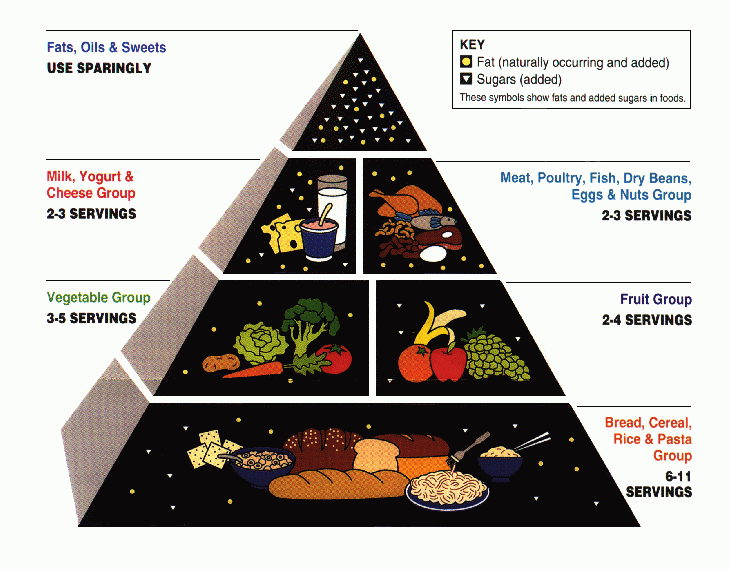
For example, here is the 1992 food pyramid as published by the USDA
It's completely upside down.. if you eat 2 or 3 servings of meat, vegetables, fruit and dairy, and 10 or 11 servings of bread and pasta a day you are in compliance with that food pyramid for a healthy diet.... You'll weigh 420 pounds but according to the USDA, you have a "balanced" diet.
Quote: That being said, I think a lot just depends on the person. I feel like different things work for different people.
I tend to agree with this statement, if only from my own experience.
When I graduated HS, I was 40 lb overweight for my height, age and bone structure. During my first year of college, I had to change my eating habits, due to finances. Dropped the fat-laden entrees and desserts (too costly), dumped the "3 squares per day" routine, and started eating more fruits/veg. When I came home after Fresh year, I weighed 170- bullseye target zone for a person with my particulars.
All that money I saved went to a new wardrobe- my clothes were falling off me.
40 years later, I still carry that same weight. I basically eat one full meal per day, and forage whatever my body craves throughout the day's activities. 3 weeks ago, my BP was 128/82.
2 years ago, I went on a cruise with my In-Laws. A solid week of 3 squares with them, and I felt like crap. Sluggish, unmotivated... it took me 2-3 weeks of my old routine to feel like myself again.
I would never recommend my food intake regimen for anyone else, but it seems to work for me. I sort of fell into it by accident, but it has served me well for 2/3 of my life. IMHO, 'three squares' are for farmers and construction crews- people who work off those calories all day long. Sedentary city folk don't need that much intake.
I never doubted that fats were good. These days, I actually ensure that I'm getting regular doses of it, and in decent quantities... whether it is animal fat, butter, oils, or avocado, I eat lots of it. A light day of training for me also burns about 900-1100 calories (today was > 1500), though, so I'm not exactly typical.
Butter is a prime example... as soon as I was old enough to shop for myself, margarine ceased to be in front of me. I won't use that crap. It's barely one molecule away from being plastic, yet people call it food? Butter, olive oil, and more recently coconut oil because it just tastes really good.
My guidelines have always been to look at how my grandparents ate. They grew up eating real food. They cooked real meals. They didn't prepare crap from a box or shrink wrapped in plastic. As a result, they lived good, long lives and were never overweight.
That's good enough for me.
Browns is the Browns
... there goes Joe Thomas, the best there ever was in this game.
Quote: how about we eat balanced diets instead of swinging the pendulum far in one direction or the other?
Because it needs to be swung pretty far back for a lot of people just to get back to "balanced". I honestly don't think most people realize how much sugar/carbs are in a lot of the foods they eat.
could be just the area I am in, but there are so many people that are on "gluten free" diets that then go more towards the old Atkins (no carbs unless unavoidable) that I don't find that healthy either.
eat healthy foods, in balance along with good exercise and you'll be pretty healthy. hasn't changed in thousands of years.
Quote: I'm good with a balanced diet, but I don't think bacon or butter or an occasional Big Mac matter nearly as much as lifestyle. IMO, a lot of people have become too sedentary - moderate and regular exercise will offset all kinds of dietary "sins".
+1
I alternate resistance training and cardio every day of the week so I can occasionally have pasta, some bread, and drink real beer. Moderation is your friend.
But yes, I'm trying to cut out gluten, flour, or grains...however you're supposed to say it. As well as other things that quickly convert to sugar once in the body.
“...Iguodala to Curry, back to Iguodala, up for the layup! Oh! Blocked by James! LeBron James with the rejection!”
Quote: I'm good with a balanced diet, but I don't think bacon or butter or an occasional Big Mac matter nearly as much as lifestyle. IMO, a lot of people have become too sedentary - moderate and regular exercise will offset all kinds of dietary "sins".
+1
I alternate resistance training and cardio every day of the week so I can occasionally have pasta, some bread, and drink real beer. Moderation is your friend.
But yes, I'm trying to cut out gluten, flour, or grains...however you're supposed to say it. As well as other things that quickly convert to sugar once in the body.
Unless you have Celiac Disease or have a pronounced (and confirmed) wheat allergy/sensitivity, don't bother. For anyone other than those people, the gluten-free thing is a fad as bad as diet soda, fat-free foods, low carb, Atkins, Paleo, South Beach, etc.....
Browns is the Browns
... there goes Joe Thomas, the best there ever was in this game.
It's sad to say but... I don't think you can trust any kind of study. No matter what it's for. There's big money being spent to get the results that benefit who ever is spending the money. This goes back to at least the '80's. When coffee prices went way up, a study suddenly found where coffee caused an increase in cancer, prices came down. The mid 90's smoking report was found to be in error, seems they left out some data that was not in their best interest. IMO it's all rigged, whatever who ever spends the most will get the results they want, right or wrong.
Dawginit since Jan. 24, 2000 Member #180 You can't fix yesterday but you can learn for tomorrow #GMSTRONG
I want to do it as a Cleveland Brown because that's who I am.”
There are companies out there that make a TON of money producing "reports" and "studies" for whatever it is you want. You can infer from that that you can decide the conclusion to be reached, and the study will be designed to get you there.
Browns is the Browns
... there goes Joe Thomas, the best there ever was in this game.
Quote: I never doubted that fats were good. These days, I actually ensure that I'm getting regular doses of it, and in decent quantities... whether it is animal fat, butter, oils, or avocado, I eat lots of it. A light day of training for me also burns about 900-1100 calories (today was > 1500), though, so I'm not exactly typical.
Butter is a prime example... as soon as I was old enough to shop for myself, margarine ceased to be in front of me. I won't use that crap. It's barely one molecule away from being plastic, yet people call it food? Butter, olive oil, and more recently coconut oil because it just tastes really good.
My guidelines have always been to look at how my grandparents ate. They grew up eating real food. They cooked real meals. They didn't prepare crap from a box or shrink wrapped in plastic. As a result, they lived good, long lives and were never overweight.
That's good enough for me.
Try some Jack....the guy was decades ahead of his time.
If everybody had like minds, we would never learn.
My daughter works for the Cleveland Clinic. She went on their low carb diet (Max carbs per day 25) under 30 puts you into ketosis. She went from 170 to 125 in 4 months with NO exercise. My son in law went on the same diet and dropped 90 pounds in 4 months. My skinny wife thought she should do the same thing but she is not so strict she is averaging about 100 carbs per day and she went from 132 to 126 in 4 weeks. My fat ass needs to drop about 33 pounds and I counted my carbs for 3 weeks and came up with a average of 300 per day. I am thinking of trying to find a way to cut down to 100 per day without giving up my beer lol
i squad 475, bench 355 and dead lift about 440, gotta work on that dead lift.
anyways, atleast with my body comp, i eat whatever the hell i want. a lot of guys do. the key is keeping your metabolism active. you can slam a 6 pack everyday if you want, but as long as you work out intensely for 30 mins to an hour, you'll be good to go.
the key isn't how long you work out, its HOW. i been in session where me and homeys are in the gym for 2 hours, yet i went with one other guy for 15 minutes and was burned out.
i think the key for people with nutruition isn't so much the food, but the inactivity COMBINED with the food we consume.
just my two cents.
“To announce that there must be no criticism of the President, or that we are to stand by the President, right or wrong, is not only unpatriotic and servile, but is morally treasonable to the American public.”
Wine has carbs. but my old ass is down to about 160 carbs per week in beer. Coors light only has 5 carbs per beer. Vodka, and whiskey have no carbs but I gave up my Jack Daniels 30 years ago when I had a bleeding ulcer,
I would do the no carbs if I could. With the way I work I eat 3 to 6 meals a week, but at least once a day I get so hungry I grab anything out of the vending machine that will fill me up for a while and there are no low carb foods in there
Well .... I don't know how these all affect us .... but I have tried to get simpler in my diet.
I have been eating a lot more fruit and vegetables, and trying to eat less processed food. It's not easy, with my back, to try and cook for myself ..... but I try to have fruit, vegetables, cottage cheese and yogurt, along with a small processed meal. I can't say that I have lost weight doing this, but I feel better in general.
If I have pasta, I have whole grain pasta. It's probably not a perfect solution, but it's a better one. My biggest problem is that I LOVE potatoes. Love, Love, Love them. I could eat potatoes for breakfast, lunch, and dinner. I should be Irish. lol However, I have tried to cut back significantly.
Micah 6:8; He has shown you, O mortal, what is good. And what does the Lord require of you? To act justly and to love mercy, and to walk humbly with your God.
John 14:19 Jesus said: Because I live, you also will live.
I try to eat organic and I try to avoid GMOs but it's really difficult. I have Crohns so I'm experimenting with avoiding chemicals and anything that might aggravate my gut. Once you start reading about what is in our food it becomes horrifying.
I'm struggling with that right now myself. I had a three day hospital stay in June. Having had open heart surgery in '06 they tell me anytime I have any type of chest pain to go to the emergency room. I had some pain and went. Turned out to be nothing but they were very concerned about my blood sugar level. It was slightly above 300.
I was given a prescription for insulin to inject every night. My blood sugar over the past three months averaged 325 a day. Way too high. They gave me instructions on a diet but that diet included carbs like bread and pasta and allowed sugar in moderation.
I'm thinking what the hell?! You want me to eat sugar/carbs and then give myself insulin injections to counter act it. Somehow, coming from the medical community that didn't make sense. If that's how they're treating diabetes it sounds crazy to me.
So I went on the Atkins diet. I done it two years ago for three months. I'd lost 35 lbs, took my blood sugar down to a three month average of 130 and all my other blood number got better. I had more energy within 2 weeks of starting the diet. Then we had a family tragedy and I found myself driving 20 miles each day to a hospital to stay with my daughter. With all the time there and all driving sometimes I'd get so hungry I'd have to stop for fast food and get on to work. I never got back on the diet.
This time I started the diet last Monday. They'd given me a blood glucose meter so I could check it myself. The first reading I took last Monday was 245 and has been steadily going down every day since. Two days ago it read 132. Today was 130. I have yet to take the insulin they gave me. Do I need insulin with a blood sugar level of 130? I don't think so.
If I keep this up this time I look forward to getting healthier.
The Atkins diet has you eating 70% fat, 20 % protein and 10% carbs from green leafy vegetables and NO sugar. This means you can't eat food out of a box nor most cans. Processed foods nearly always contain sugar and most of them contain extra salt in an effort to give it some flavor. Actually, salt is the flavor a lot of people crave because they eat so much of it on a daily basis through processed foods. The Atkins diet tells you to go ahead and salt your food at the table. (doctors will tell you no) because you're no longer getting it through those processed foods so your table salt is not too much for you.
That is the induction phase of Atkins to get your body into ketosis. That's when the body switches from being a carbohydrate-burning organism into a fat-burning one. (After this first two weeks it slowly adds in certain carbs until by the time you get to the last phase Phase 3, you are eating a wide selection of foods)
You see, nutritionists will tell you our bodies need carbs to burn for energy. Which is why they include bread, pasta and sugar in their suggested diets. But more to the reality of it is your body burns carbs for energy because that's what we eat.
If we eat fat and very low carbs our bodies switch to burning fat for energy. Eating as the Atkins diet suggests one does not gain weight from the fat but loses weight due to the fat burning because your burning more fat than your eating.
One might think, yeah but gorging on bacon and burgers and other high fat meats cannot be good for you. Well, you don't gorge. Eating fat satisfies your hunger and lasts longer. So instead of eating a big bowl of pasta (carbs) which spikes your blood sugar level and then getting ravishingly hungry a couple of hours later when your blood sugar drops, eating fat keeps you satisfied, does not spike your blood sugar so you tend to not overeat.
My usual uncontrolled eating habits had me eating 3000-4000 calories per day. Mostly carbs. I can't burn off all that. On this diet I rarely hit 2000 and none of it is carbs. The weight melts away, the blood sugar level drops and by virtue of the weight loss blood pressure improves.
Contrary to popular belief, or what the medical profession will tell you, your cholesteral level doesn't go high. That's because, as in my case, I'm actually eating less meat than before because, like I mentioned, you tend to not overeat because your hunger is satisfied. It's the carbs that cause us to overeat. The carbs in the form of bread, pasta and sugar.
You can pretty much take the food pyramid and turn it upside down. The only thing they got right was limiting sugar. Heck, with all those servings of bread, pasta and whole grains our National Health Organization and in turn all the medical profession suggests sugar would simply be the dagger to the heart. The very heart they claim to be trying to save. Instead they're killing it but continue to stick to their guns that they're right.
I've recently been accepted into the VA Healthcare. For about a month now. Contrary to what you see hyped on TV, they are a great facility. On this coming Tuesday I have an appointment to attend a special diabetes group. I'm to bring my blood glucose meter from which they can download all the readings I've taken since I started using it two weeks ago. They're going to freak out when they see my low blood sugar level having not taken any of the insulin they said I so desperately needed and which my family doctor agreed.
This morning for breakfast I had 5 strips of bacon and three eggs fried in the bacon fat. An hour later my blood sugar was 130. Try that with 3 pieces of whole grain bread and 3 poached eggs and a piece of fruit.
I drink only coffee with heavy cream (contains no carbs), iced tea with no sugar and water. The diet does not limit you to that. You're allowed diet soda and to use Spenda for a sweetner for any drink. But I'm not fond of the taste of artificially sweetened foods or drinks. And the truth is that after 4 days I no longed missed the sugar or the bread and I'm a guy who could routinely eat a half-loaf of bread a day.
Some one alluded earlier in this thread that Atkins was a fad. Well, it's not a fad, it works, it's healthy and as the OP article states we've been being lied to about fat for the past 30 years. The Atkins diet had the medical community up in arms when it first came out due to it's method of eating. Now people are realizing that saturated fat is not the evil we've been told it was.
It would behoove anyone who is having health problems or weight problems to look into it or similar diet like the Paleo which is a bit more forgiving/less strict in the beginning.
Quote: Do I need insulin with a blood sugar level of 130? I don't think so.
You should talk to your doctor anyway.
I take Metformin for my diabetes. My blood sugar has fairly consistently been in the 130-140 range. 130 is still not a good blood sugar level.
Micah 6:8; He has shown you, O mortal, what is good. And what does the Lord require of you? To act justly and to love mercy, and to walk humbly with your God.
John 14:19 Jesus said: Because I live, you also will live.
I have talked to my doctors in the VA and my family doctor. I've been told to aim for 70-130 as a blood sugar level.
My point was that starting at 245 a little over a week ago and bringing it down to 130 in that time is pretty darn good without the insulin. And this is just a start.
Diabetes is an A1C of 6.0 or higher. An A1C of 6 is the daily average blood sugar level of 128.
The last time I did Atkins I brought mine from 9.5 down to 6.1 in three months. I hadn't had it checked again until the hospital visit I mentioned when it was 12.8 which is a daily average blood sugar level of 325.
The doctors have told me to shoot for an A1C of 7 which is an average daily blood sugar level of 154 being controlled by insulin
I realize this sounds like they've contradicted themselves but the 70-130 spread was for me to recognize if my blood sugar got too low, which can happen when using insulin. Being at 130 this morning, what the heck would it have been if I'd taken insulin last night?
I'm not eating any sugar and very few carbs and none of those carbs come from food containing sugar.
I don't think I'm there yet or that my diabetes has been cured. But I feel I'm well on my way to a much healthier, consistent blood sugar and that's the real goal and the opposite of diabetes.
btw... I love, love, love potatoes too. If I'm missing anything it's that.
They are probably trying to determine how the medication affects your particular case.
My doctor, for example, wanted me to be in the 100-130 range, but was not upset by 130. Unfortunately, my blood sugar appears to be unaffected by an increase in the level of my medication. I was around 130 .... and my doctor increased my medication from 2X to 3X/day ..... and it was unaffected, so he increased it to 2 pills 2X/day. My blood sugar remains int he same zone, so I don't know what the next step will be. However, for my doctor, anyway, he takes small steps to see what effect small changes have. I would guess that is what your doctor wants as well.
Micah 6:8; He has shown you, O mortal, what is good. And what does the Lord require of you? To act justly and to love mercy, and to walk humbly with your God.
John 14:19 Jesus said: Because I live, you also will live.
Has he instructed you to change your eating habits? If you cut way back on your sugar consumption and fast carbs (breads & pasta for instance) it could make a big difference. Whole wheat bread and pasta does nothing but give you nutrients you wouldn't have gotten from the non-whole wheat types. That will do nothing to improve your blood glucose level. Plus, you have to really read the nutrition label. A lot of those whole wheat products use a lot of added sugar to make it more tasty.
It's all about the sugar and the carbs that turn into sugar and then stored in your body as fat. Is he telling you any of this?
That's one of the gripes I have with the medical profession. They tend to ignore the cause and treat the symptoms. The diet they wanted me to go on included breads, pastas and sugar in moderate amounts. Then they wanted me to take insulin to counteract that.
My sugar level was 128 this morning. It's been dropping steadily since last Monday when I started the diet. Of course, I am eating NO sugar at all. It only takes me about 3-4 days to get over the craving for it.
When I did this before, if I suddenly got a sweet tooth, I'd get a diet soda. I don't particularly like the taste (I liked Pepsi Zero the best) but it tastes sweet even though it tastes fake. It used to take me three days to drink one.
And before anyone thinks I'm caught up on some "diet fad" and am trumpeting the high fat/low carb way of eating to improve health just know that I did this previously for 3 months. All my blood work numbers improved greatly, not just blood glucose, my cholesterol numbers came down and I felt great while losing 35 lbs without exercise.
I'm a believer because it's already worked for me before. Had I stuck with it I wouldn't have the issues I have today i.e. overweight/diabetes. I'm looking to reverse those conditions as much as possible in an effort to avoid some medications or at the lest take only a minimum amount of them.
In case you don't check the link I posted above I wanted to be sure you saw this warning about starting Atkins if you're already taking insulin. Atkins suggests you consult your doctor first for the reasons given below...
Both diets- low-carb and low glycemic- improved Hemoglobin A1c as well as fasting glucose, fasting insulin and even weight loss. But the low-carb (Atkins Induction) diet did slightly better on all four counts. Both groups were also able to reduce their diabetic medication. But in patients taking insulin, the effects of the Atkins Induction diet were really quite powerful. Participants taking from 40-90 units of insulin before the study were able to eliminate their insulin use after starting the Atkins Induction diet, sometimes so quickly that the study researchers had to issue the warning that subjects with type 2 diabetes who are unable to adjust their own medication shouldn’t make these dietary changes without close medical supervision!
All I'm trying to do is eliminate my insulin use before I have to start taking it.
Quote: could be just the area I am in, but there are so many people that are on "gluten free" diets that then go more towards the old Atkins (no carbs unless unavoidable) that I don't find that healthy either.
It depends on your lifestyle. If you are active and exercise a lot you need more carbs but you need them from better sources.
Quote: eat healthy foods, in balance along with good exercise and you'll be pretty healthy. hasn't changed in thousands of years.
No it hasn't, what has changed is our lifestyle. As others have pointed out, most people live a rather sedentary lifestyle these days, even if you workout hard for 60-90 minutes a day, that's completely different than working on your feet and with your hands all day like most people used to.
the impetus behind posting the article and starting the discussion was to talk about what that word really means "balance"... because what many experts are advocating today as balance is not what we have all been taught for the last 40 years.
Stay active, avoid as many processed foods as possible, be active, don't gorge yourself when you eat a meal, do activities, drink water, keep yourself active, avoid carbonated and sugary beverages. Did I mention don't be a slothe?
We don't have to agree with each other, to respect each others opinion.
Quote: talk about what that word really means "balance"
well, that is the tricky part and I think largely depends on exactly what you are doing for a living (as you mentioned) and your overall lifestyle.
I think it does begin with eliminating the thought of a diet like Atkins for healthy people (I do see it's benefits for those that have issues with sugars or grains). Going into a minimization instead of moderating things seems wrong to me (that goes the other way of taking away fats/meats too).
Quote: I try to eat organic and I try to avoid GMOs but it's really difficult. I have Crohns so I'm experimenting with avoiding chemicals and anything that might aggravate my gut. Once you start reading about what is in our food it becomes horrifying.
I completely agree. I'm starting to think that science ruined food
Quote: I completely agree. I'm starting to think that science ruined food
It's part science, it's part need. We NEED to produce more food without increasing the size of farms exponentially to do it, science has helped with that. We also NEED to be able to cook meals quicker because of our lifestyle not allowing us an hour and a half to make dinner, science has helped with that... but yes, there is a definite cost that goes along with that. It's very challenging and expensive to actually eat well these days.
From a cost and yield-per-acre, definitely. GMOs and chemicals definitely allow us to produce at higher levels. Ockham's Razor, we'd have major shortages and further global starvation if everyone went organic tomorrow.
Now, I believe we still could feed the entire planet without chemicals and genetically modified foods. Like you said, we'd have to put more space and energy into it. We might have to grow more food on our own property or transform more urban wastelands. Plus, we have a lot of agricultural industry that is essentially ornamental (floral, lawn, decorative) that could, perhaps should, be transformed into food production.
The 1 cost thing that doesn't make sense: reduced sodium foods are often priced higher. It costs more to put less salt in the soup!








![[Linked Image]](http://www.dawgtalkers.net/uploads/Punchsmack/punch.gif)

![[Linked Image]](http://www.dawgtalkers.net/uploads/small-gator-chomp.gif)