|
|
Joined: Sep 2006
Posts: 8,556
Hall of Famer
|

Hall of Famer
Joined: Sep 2006
Posts: 8,556 |
I can tweet a pic of me dunking also, photshop is a wonderful thing.
|
|
|
|
|
Joined: Sep 2006
Posts: 77,246
Legend
|
|
Legend
Joined: Sep 2006
Posts: 77,246 |
Analytics should tell people your odds of getting quality players in round 3 on down is far rarer than getting higher rated players earlier. I guess they only want to use real statistics when it suits them. Sometimes less is more.
Intoducing for The Cleveland Browns, Quarterback Deshawn "The Predator" Watson. He will also be the one to choose your next head coach.
#gmstrong
|
|
|
|
|
Joined: Jan 2009
Posts: 42,413
Legend
|
|
Legend
Joined: Jan 2009
Posts: 42,413 |
I can a pic of me dunking also, photshop is a wonderful thing. How about a video?
|
|
|
|
|
Joined: Jan 2009
Posts: 42,413
Legend
|
|
Legend
Joined: Jan 2009
Posts: 42,413 |
Analytics should tell people your odds of getting quality players in round 3 on down is far rarer than getting higher rated players earlier. I guess they only want to use real statistics when it suits them. Sometimes less is more. Increase the odds my having more picks. This isn't that hard.
|
|
|
|
|
Joined: Sep 2006
Posts: 77,246
Legend
|
|
Legend
Joined: Sep 2006
Posts: 77,246 |
Decrease the odds by drafting far more mediocre players?
Intoducing for The Cleveland Browns, Quarterback Deshawn "The Predator" Watson. He will also be the one to choose your next head coach.
#gmstrong
|
|
|
|
|
Joined: Apr 2007
Posts: 17,284
Legend
|
|
Legend
Joined: Apr 2007
Posts: 17,284 |
Adam Schefter ‏@AdamSchefter 3m3 minutes ago
Dr. James Andrews, who examined Myles Jack in December, told the UCLA LB today that he does not need micro-fracture surgery. Big news considering some of the rumors today are that were trying to see if Jack is worth the gamble or not
|
|
|
|
|
Joined: May 2008
Posts: 8,660
Hall of Famer
|
|
Hall of Famer
Joined: May 2008
Posts: 8,660 |
I do not have an issue trading down if they are trying to accumulate as much ammo as possible to get back into the 2nd round later.
Trade down for a lower 2nd maybe only a few spots to Dallas and then trade some of the extra 3rd and 4th to get back into the 2nd.
I would do so in a heart beat. There are impact players to be had deep into the 2nd. After that they will be drafting players that can start and/or provide depth. I agree ... thinking two picks in the 2nd ... I think we have enough ammo now.
|
|
|
|
|
Joined: Sep 2006
Posts: 17,475
Legend
|
|
Legend
Joined: Sep 2006
Posts: 17,475 |
With ease...cause he's a great athlete...but also as gingerly a dunk that I can remember seeing. He had to do something though...I feel for the guy man...such a good football player.
Defense wins championships. Watson play your butt off!
Go Browns!
CHRIST HAS RISEN!
GM Strong! & Stay safe everyone!
|
|
|
|
|
Joined: Apr 2007
Posts: 17,284
Legend
|
|
Legend
Joined: Apr 2007
Posts: 17,284 |
Ian Rappaport says we will have a deal in place for 32 and we're going to challenge the record for most draft picks.
|
|
|
|
|
Joined: Sep 2006
Posts: 50,717
Legend
|
|
Legend
Joined: Sep 2006
Posts: 50,717 |
Got news for you...we actually would like to WIN this year... We want to win long term. That means getting young players experience as soon as possible. Playing 30+ year old guys, for the most part, makes little sense.
Micah 6:8; He has shown you, O mortal, what is good. And what does the Lord require of you? To act justly and to love mercy, and to walk humbly with your God.
John 14:19 Jesus said: Because I live, you also will live.
|
|
|
|
|
Joined: Sep 2006
Posts: 12,058
Legend
|
|
Legend
Joined: Sep 2006
Posts: 12,058 |
http://www.cantonrep.com/sports/20160429...e-them/?Start=1Browns drive bidding war (plus, list of Day 2 players who intrigue them) By Steve Doerschuk 
Repository sports writer Posted Apr. 29, 2016 at 3:14 PM The Browns head into the second day of the draft with a boatload of options. In second and third rounds to be conducted tonight, they have scheduled picks at No. 32, No. 65, No. 76 and No. 77. Those four picks give them more than are owned by any of the other 31 teams. There is a good chance they will trade down for the third time in this draft, depending how far they would have to drop from 32 and how much they would get in return. Multiple teams have inquired about getting into the 32nd spot, and the Browns have spent the day promoting a bidding war. One player everyone is watching is Michigan State quarterback Connor Cook. If the Browns don't want him at 32, someone else might. Linebacker Myles Jack, a top-five talent whose knee issues dropped him out of the first round, could be a target of the New York Giants, who are scheduled to pick at No. 40. Mel Kiper sees Cook as the best QB left and the 12th-best overall prospect still on the board. Dallas, sitting at No. 34, is likely to be in any bidding war. The Cowboys wouldn't so much be trading up "only two spots" as they would be overpaying to keep some other team from getting to 32. They want pass rushers, and a couple are available. The guess is the Browns wouldn't trade down far. Here is a look at some of he players still on the board who might interest them with their first round pick and then with their early third-round pick. They have the ammo to trade up for a second Round 2 pick. ALABAMA RB DERRICK HENRY Hue Jackson wants to build an elite running game while his pass offense figures itself out. The organization is not sold on 2015 rushing leader Isaiah Crowell but likes 2015 Round 3 pick Duke Johnson. A one-two punch featuring Henry as the big back and Johnson as a dynamic part of a one-two punch is intriguing. The 6-foot-3, 247-pound Henry rushed for 4,261 yards as a national high school player of the year and won the Heisman Trophy on a national championship team. Obviously, the Browns don't want another Trent Richardson, but there are obvious differences, and the team is evaluating Henry on his own merits. NOTRE DAME RB C.J. PROSISE Some compare him to Fred Jackson, who helped Jacksonville put up a 14-2 record early in his career. He is faster than Henry and is big enough (6-0, 220). His speed might make him more appealing to Hue Jackson than Henry. CLEMSON DE KEVIN DODD There are questions about where the 6-5, 277-pounder would fit in Cleveland's scheme, but one theory has it that he is good enough for a coordinator to adapt. Gil Brandt ranked him as the 16th-best player available at the start of the draft. He had at least one sack in his last five college games. BOISE STATE DE KAMALAI CORREA The 6-3, 243-pounder projects as a 3-4 outside linebacker. He was seen as a late first-round value. If the Browns pick Correa or someone like him this high, it would be a sign they are not high on 2015 Round 2 pick Nate Orchard. They haven't tipped their hand on their views of Orchard. OHIO STATE WR MICHAEL THOMAS At 6-foot-3, he could be the big outside receiving threat opposite first-round pick Corey Coleman. He has the height, weight and speed of a No. 1 wideout, but his attention to detail is a weakness that makes him difficult to project. CLEMSON CB MACKENSIE ALEXANDER The longer the team waits to take a corner, the more it would be evident Ray Horton thinks he can make something of 2014 No. 8 overall pick Justin Gilbert. If a corner is desired, Alexander has the kind of spunk Horton likes. INDIANA OT JASON SPRIGGS A four-year starter, he showed enough improvement to make scouts wonder if he could become Joe Thomas' replacement at left tackle down the road while competing for a starting job elsewhere on the line now. He is a somewhat slender 6-foot-6 and will have to bulk up. OHIO STATE WR BRAXTON MILLER The Browns already have one project wide receiver who is a former Ohio State quarterback. But this guy has a jump on Terrelle Pryor in that he has a year at wideout under his belt after playing QB for the Buckeyes in 2011, 2012 and 2013. Miller is an older rookie, turning 24 in November. He is more than a year older than Johnny Manziel. It would be a curiosity to have three former Buckeyes, Miller, Pryor and Brian Hartline, in the Browns' receiving corps. OHIO STATE SAFETY VONN BELL The Browns lost Tashaun Gipson in free agency and cut Donte Whitner. They added former Round 2 pick Rahim Moore, but he is a reclamation project, and help is needed. Bell has the instincts, toughness and leadership gene former safety Ray Horton admires. Reach Steve on Twitter: @sdoerschukREP
#gmstrong
|
|
|
|
|
Joined: May 2015
Posts: 5,386
Hall of Famer
|
|
Hall of Famer
Joined: May 2015
Posts: 5,386 |
Decrease the odds by drafting far more mediocre players? It get so tiring to answer this over and over again only to see it repeated 1000 times more. Please read this. http://www.vox.com/2014/5/7/5683448/how-...rs-irrationallyHow NFL teams ignore basic economics and draft players irrationallyThe NFL draft begins on Thursday. In the football world, it is a huge deal. For non-football fans: this is when NFL teams select college football players to add to their rosters, the new players awkwardly hold up jerseys with the number one on them, and football fans everywhere freak out. The worst teams are given the highest picks, and if they want to improve, they need to use them as shrewdly as possible. Teams that succeed — like the Seattle Seahawks, winners of this past season's Super Bowl — tend to build their rosters heavily through the draft, and merely supplement their drafted talent through trades and free agency. NFL executives invest huge amounts of time and resources into scouting players and ranking them, hoping to draft stars in the first round and solid contributors later on. But here's the thing: despite years of data, most NFL teams still have no idea how to work the draft most effectively. It's not their imperfect player evaluation, but something more basic — their refusal to follow the principle of risk diversification. That's the conclusion economists Cade Massey and Richard Thaler came to after analyzing fifteen years of draft data in a series of papers — and it's still true, despite recent changes to the wages rookies are paid. Draft picks can be traded, and the success of any one player picked is highly uncertain. Because of that, their data says that in the current trade market, teams are always better off trading down — that is, trading one high pick for multiple lower ones — but many teams become overconfident in their evaluation of one particular player and do the exact opposite: package several low picks for the right to take one player very early. "There are one or two teams out there that philosophically follow this idea," says Massey, who serves as a draft consultant with several NFL teams that he can't disclose. "But in my experience, teams always say they're on board with it in January. Then when April rolls around, and they've been preparing for the draft for a long time, they fall in love with players, get more and more confident in their analysis, and fall back into the same patterns." 1) It's just not worth it to trade upThe first analysis Massey and Thaler did was to compare what teams are willing to pay to pick higher (in terms of extra draft picks packaged as part of a trade) with the value they ultimately get out of doing so, in terms of player production. To calculate how much teams pay to trade up, they looked at 1,078 trades made between 1990 and 2008. The trades work something like this: a team will trade the 16th and 32nd overall picks, say, for the 5th overall pick. They might also include picks from next year's draft. Massey and Thaler graphed all trades, which let them assign a relative value to each pick in the first five rounds of the draft: 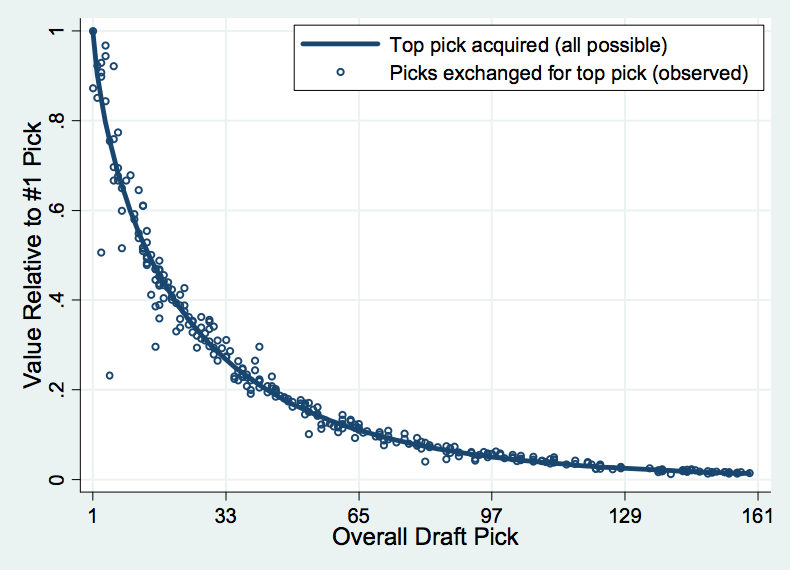 The most important thing about this graph: the curve is very, very sharp in the first round (picks 1 through 32). That means teams think the very top picks are extremely valuable: the value of the 10th pick is only about half that of the first pick. Now, it's worth pointing out that for years, most teams followed something called "The Chart," which assigned theoretically fair point values to each pick in the draft for trade purposes. Since 2008, many teams have smartly stopped treating "The Chart" as gospel, and the curve has become slightly less steep. But Massey says it still hasn't flattened out to anything near where it should be, in terms of the actual value derived from the players picked. He and Thaler figured this out by calculating the odds that the first player picked at any given position will perform better — in terms of the number of games he starts in his first five seasons — than the second player drafted at that position. This is relevant because a team will often trade up when they identify a player they prefer at a needed position: they need a wide receiver, and a few highly-rated ones are available, but they trade up because they're certain one is much better. But the data says that teams just aren't very good at figuring out when this is true. On average, the chance that first player will start more games than the second one picked at his position: 52 percent. Compared to the third, it's still only 55 percent, and compared to the fourth, it's merely 56 percent. THE CHANCE THAT THE FIRST PLAYER PICKED AT A POSITION WILL START MORE GAMES THAN THE SECOND IS JUST 52 PERCENTThese numbers suggest that moving up eight picks (the average distance between the first and second players at the same position) should cost a small amount, since you're only increasing the odds of a getting a more productive player by four percent or so. But as the steep curve shows, teams pay a ton to move up, especially at the top of the draft. "It's basically a coin flip," Massey says, "but teams are paying a great deal for the right to call which side of the coin." One recent trade epitomizes this point — and shows that even in the post-"Chart" era, teams still overvalue the highest picks. In 2012, the Washington football team traded the 6th pick, the 39th pick, and their first round picks in 2013 and 2014 to the St. Louis Rams so they could move up four spots and take Robert Griffin III — a player they were certain was a once-in-a-lifetime quarterback — with the second overall pick. Just two years later, the trade already looks pretty shortsighted. That's not because Griffin is a bad player (he's almost one of the few that might make a crazy trade like this seem worthwhile), but because the odds of getting a great player with one high pick are so much lower than getting one with four high picks. The team would've been better served sitting tight and just drafting the next-best quarterback (Ryan Tannehill) and using the other three picks on much-needed players. Or they could have waited and drafted a quarterback this year — say, Johnny Manziel — when they would've had the 2nd overall pick themselves if they hadn't made the trade. 2) It really pays off to trade downGiven that teams, on the whole, are irrationally willing to pay a lot to trade up, smart teams can reap huge benefits by trading down. Even staying put and drafting from your original spot, the researchers' analysis shows, is not a good strategy. For each pick in the first round, they calculated all of the different two-pick packages a team could've gotten by trading down, based on the historical data (a team with the first pick, for instance, could get the 2nd and 181st picks, or the 14th and 15th picks, or any combination of picks in between that provide the same sum value). Then they calculated what teams get out of these picks on average, in terms of the number of starts a player provides in his first five years and the number of Pro Bowls he's voted to. (They included Pro Bowls to counter the criticism that their analysis ignores the unique impact of superstar players solely available in the first few picks.) Again, the data was unequivocal. On average, trading down and getting two players gave a team five more starts per season and slightly more total Pro Bowls. You could chalk this up to the simple fact that more players start more games, but it's more than that. Even if you imagined that the team trading down could only keep the better one of the two players it drafted, it'd still get slightly more total starts and the same number of Pro Bowls. The truth is that teams are imperfect talent evaluators, so having two later picks is better than a single early one. Risk diversification at work. 3) Players picked lower are cheaperAll of these reasons to trade down don't even include the fact that players picked later in the draft get paid lower salaries, because the NFL collective bargaining agreement sets wages for the first few years of players' careers based on their draft slot. Saving money matters because all teams have to abide by a hard salary cap — this year, it's $133 million — so paying less to draft picks means more is left over for veteran players. For every single spot in the draft, the researchers compared the amount of salary paid to a player with the value a team gets from him on the field. (For this analysis, they used a more sophisticated metric for value: they looked at the average statistical production yielded by a player taken at that spot of the draft between 1994 and 2008, then converted that into dollars, based on what teams paid a player with that level of production on the free agent market on average). In the graph below, the red line is the actual salary paid to a player picked at each spot, the green line is the average performance provided, and the blue is the difference — the money you save drafting someone at that spot instead of having to pay more for a veteran free agent who'd play at a similar level. 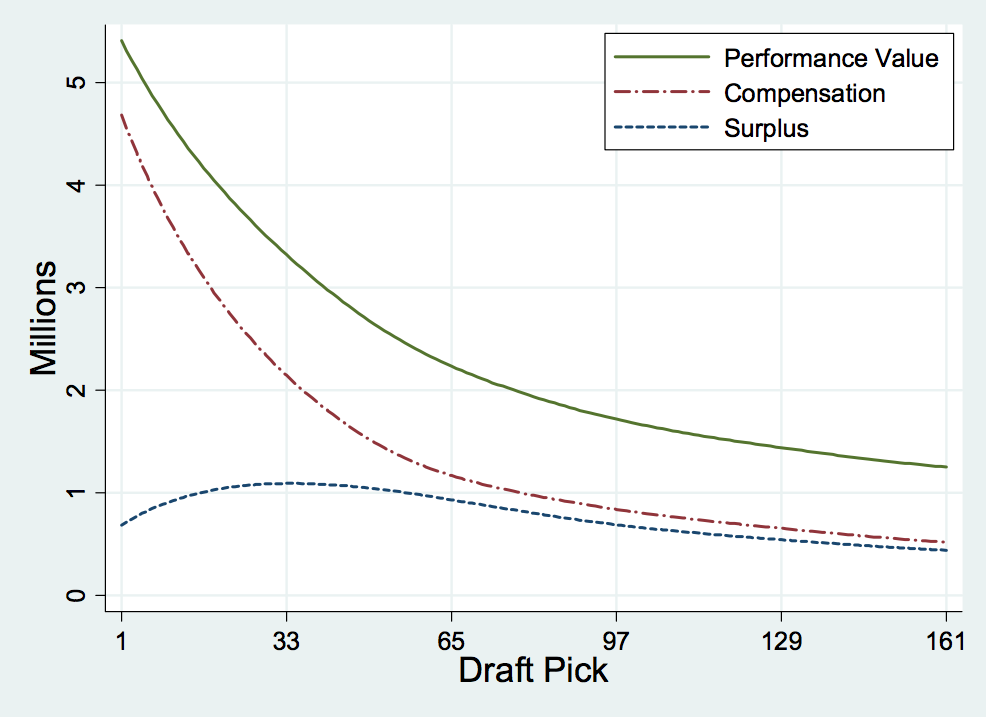 Massey and Thaler 2012 The blue line peaks around pick 33, the start of the second round — making it the sweet spot in the draft. If you had to make one pick, this is where you'd get the most bang for your buck, because there's a pretty good chance of getting a productive player and he won't command a particularly high salary. But since you can get multiple picks by trading a single high one, maximizing value means moving down into round two (picks 33 through 64). One caveat is that the salary data comes from picks made under the old NFL collective bargaining agreement, which paid players picked in the top 10 considerably higher salaries then they get currently. But the salaries for picks from 10 onward have barely changed — and because trading down is so much more fruitful, Massey says the argument still applies for the first round as a whole. 4) Teams that trade down more often win more games The most straightforward piece of proof for all this analysis is the fact that trading down and amassing more pick value — in terms of the blue line in the graph above — correlates with more wins on the field. Massey and Thaler came to this conclusion by looking at the number of wins a team had in any given season between 1997 and 2008, and the total value of all picks they'd made in the previous four years (the amount of time, on average, a rookie is under contract for). They found that one standard deviation in pick value translated to 1.5 more wins per season on the field. Sure, it's a small sample size, and there's a lot of chance and other factors built into the system — a coach's strategy, for instance — but trading down correlates with a significant amount of victories, given that there are only 16 games in a season. So why don't more NFL teams follow this advice?Baltimore Ravens GM Ozzie Newsome knows how to draft. Photo by Rob Tringali/SportsChrome/Getty Images If all teams took note of these findings and corrected their behavior, the principles would no longer apply. Teams would be much less interested in trading up, so the lucrative market for trading down would evaporate. Why hasn't this happened? One answer is a widely-known psychological bias called the overconfidence effect. As people are given more information, the accuracy of their analysis often hits a ceiling, but their confidence in it continues to increase. This tendency has been demonstrated in all sorts of areas, from bettors picking horses to psychologists making diagnoses. It's not hard to imagine that NFL general managers — who are given scouting reports on players that cover everything from their body fat percentage to their home life — fall victim to the same sort of overconfidence and, as Massey said, "fall in love" with certain players. There's also the fact that the sports world as a whole tends to glamorize superstars — leading many to disproportionately attribute a 53-player roster's success to one or two highly drafted players. For a struggling GM, it might seem much easier to trade up and land a guaranteed superstar than patiently fill a roster with competent players. The problem, though, is that there are no guaranteed superstars — and Thaler and Massey have found that, given a long enough timeframe, no teams are any better at accurately evaluating prospects than others. Sure, a GM might hit a hot streak over the course of a few drafts, but long-term, they estimate that 95 to 100 percent of the difference in teams' odds of striking gold with any one pick is driven by chance. So the key isn't drafting better — it's just drafting more. As Cassey noted, there are a few teams out there following his philosophy. In a recent interview, Eric DeCosta — assistant GM of the perennially-successful Baltimore Ravens — dropped a hint about the identity of one of them: We look at the draft as, in some respects, a luck-driven process. The more picks you have, the more chances you have to get a good player. When we look at teams that draft well, it’s not necessarily that they’re drafting better than anybody else. It seems to be that they have more picks. There’s definitely a correlation between the amount of picks and drafting good players.
|
|
|
|
|
Joined: Sep 2006
Posts: 77,246
Legend
|
|
Legend
Joined: Sep 2006
Posts: 77,246 |
You can use some guy from vox.com all you like. You can try to play the numbers game all you like. And outside of a franchise QB, a trade we made going from #2 to #8 is a good trade of value. Even our trade from #8 to #15 had great value looking at who was on the board. See, that's the issue you are failing to address.
You wish to use ALL TRADES considering you are posting this article. My point is when you get to the second round and beyond. My point is there has to be some cut off point at which time the talent level greatly decreases in the draft. At what point to do players mean more than bodies? Because there is most certainly a point at which that happens.
What it appears to me you're trying to say is that if you keep trading down until you acquire the entire seventh round, we win. I don't believe that for a second.
Intoducing for The Cleveland Browns, Quarterback Deshawn "The Predator" Watson. He will also be the one to choose your next head coach.
#gmstrong
|
|
|
|
|
Joined: Mar 2013
Posts: 15,341
Legend
|
|
Legend
Joined: Mar 2013
Posts: 15,341 |
When did we trade for someone's 7th rd. pick pitDAWG? 
Last edited by PastorMarc; 04/29/16 02:45 PM.
John 3:16 Jesus said "For God so loved the world that He gave His only begotten Son, that whoever believes in Him should not perish but have everlasting life."
|
|
|
|
|
Joined: May 2015
Posts: 5,386
Hall of Famer
|
|
Hall of Famer
Joined: May 2015
Posts: 5,386 |
You can use some guy from vox.com all you like. You can try to play the numbers game all you like. And outside of a franchise QB, a trade we made going from #2 to #8 is a good trade of value. Even our trade from #8 to #15 had great value looking at who was on the board. See, that's the issue you are failing to address.
You wish to use ALL TRADES considering you are posting this article. My point is when you get to the second round and beyond. My point is there has to be some cut off point at which time the talent level greatly decreases in the draft. At what point to do players mean more than bodies? Because there is most certainly a point at which that happens.
What it appears to me you're trying to say is that if you keep trading down until you acquire the entire seventh round, we win. I don't believe that for a second. Apparently you spent a lot of time reading that didn't you? That study was done by 2 economics professors from Yale and the University of Chicago. Vox just reported on the study. If you do bother to actually read it you'll see a bunch and math and charts and technical type stuff that prove that you don't have any idea what you are talking about. The study was conducted on 15 years of NFL drafts and shows what you think happen and what actually happen don't agree.
|
|
|
|
|
Joined: Sep 2006
Posts: 77,246
Legend
|
|
Legend
Joined: Sep 2006
Posts: 77,246 |
When did we trade for someone's 7th rd. pick pitDAWG? I think you need to read the article I based that post on. It speaks in generalities regarding trade downs and how great they are. The fact is, the later the round that you draft in, the odds go down on success. If you try to extrapolate that always trading down is a good thing, where do you end up? The only way I see stalking up on fourth and fifth round picks is a good thing, is if you plan to use them as ammunition to trade back up in the draft. According to the article, trading up is a losing proposition. At some point that example doesn't hold water.
Intoducing for The Cleveland Browns, Quarterback Deshawn "The Predator" Watson. He will also be the one to choose your next head coach.
#gmstrong
|
|
|
|
|
Joined: Mar 2013
Posts: 15,341
Legend
|
|
Legend
Joined: Mar 2013
Posts: 15,341 |
John 3:16 Jesus said "For God so loved the world that He gave His only begotten Son, that whoever believes in Him should not perish but have everlasting life."
|
|
|
|
|
Joined: Dec 2014
Posts: 595
All Pro
|
|
All Pro
Joined: Dec 2014
Posts: 595 |
I'd be more than happy if we can snag a second #2 for next year to move down no more than 8-9 spots. That would put us in a commanding position to dictate next year's draft, and unless RGIII really balls out, go up and get whatever QB we want.
Last in, first out, the sign of a true champion!![[Linked Image from i301.photobucket.com]](http://i301.photobucket.com/albums/nn59/Stetson1376/c8f5fed9-fc01-4b87-bda3-b2b53f0b16cb_zpse708e05e.jpg)
|
|
|
|
|
Joined: Mar 2013
Posts: 2,218
Dawg Talker
|
|
Dawg Talker
Joined: Mar 2013
Posts: 2,218 |
Pitt, you assume people can consistently evaluate at a high level for extended years. You also assume level of talent remain consistent each draft. By that I mean, talent level at specific position can be very good one year and a seventh round succeeds equally as a 3rd or 4th round. It is possible talent level is poor and a first round pick is no better than a third round.
A good example a bomber pilot taking out a target. He has a better chance destroying it with 100 bombs than using only a 10. Quality is not the issue. It is the amount of variables that can skew results.
|
|
|
|
|
Joined: Sep 2006
Posts: 2,540
Dawg Talker
|
|
Dawg Talker
Joined: Sep 2006
Posts: 2,540 |
we run a 3-4,the most important component of the 3-4 is the 4 and ours suck.
We need a rush OLB,we need a run stopper in the middle.And chances are real good that we are going to have to be replacing Mingo and Kruger after the '16 season.
As I see it,4 LB's need to be drafted,with pass rusher being the most important,so get one at 32.
Indecision may,or maynot,be my problem
|
|
|
|
|
Joined: Mar 2013
Posts: 15,341
Legend
|
|
Legend
Joined: Mar 2013
Posts: 15,341 |
If we trade down a little then take Ragland I would be ok with that ...
Last edited by PastorMarc; 04/29/16 03:20 PM.
John 3:16 Jesus said "For God so loved the world that He gave His only begotten Son, that whoever believes in Him should not perish but have everlasting life."
|
|
|
|
|
Joined: Sep 2006
Posts: 75,063
Legend
|
|
Legend
Joined: Sep 2006
Posts: 75,063 |
we might just have 15 picks the next 3 years ... and just see who sticks
like buying lotto tickets
"First down inside the 10. A score here will put us in the Super Bowl. Jeudy is far to the left as Njoku settles into the slot. Tillman is flanked out wide to the right. Judkins and Ford are split in the backfield as Flacco takes the snap ... Here we go."
|
|
|
|
|
Joined: May 2008
Posts: 8,660
Hall of Famer
|
|
Hall of Famer
Joined: May 2008
Posts: 8,660 |
we run a 3-4,the most important component of the 3-4 is the 4 and ours suck.
We need a rush OLB,we need a run stopper in the middle.And chances are real good that we are going to have to be replacing Mingo and Kruger after the '16 season.
As I see it,4 LB's need to be drafted,with pass rusher being the most important,so get one at 32.
Kamalei Correa
|
|
|
|
|
Joined: Feb 2007
Posts: 4,753
Hall of Famer
|
|
Hall of Famer
Joined: Feb 2007
Posts: 4,753 |
We would only be giving up two selections ... What would it take in compensation? I'd ask for #34 and a 3rd next year I'd settle for #34 and a 4th this year. Pass rusher would not surprise me, but Cook or Hackenburg wouldn't surprise me either
|
|
|
|
|
Joined: May 2008
Posts: 8,660
Hall of Famer
|
|
Hall of Famer
Joined: May 2008
Posts: 8,660 |
We would only be giving up two selections ... What would it take in compensation? I'd ask for #34 and a 3rd next year I'd settle for #34 and a 4th this year. Pass rusher would not surprise me, but Cook or Hackenburg wouldn't surprise me either I dont like the trade if they were only offering a 6th round pick ... A 5th would work, trouble is the Cowboys don't have one two trade.
|
|
|
|
|
Joined: Feb 2007
Posts: 13,358
Legend
|
|
Legend
Joined: Feb 2007
Posts: 13,358 |
If they want a QB, I'd take #34 and a 4th. If they want Alexander or Spence, I want a lot more than that before I think about it.
|
|
|
|
|
Joined: May 2008
Posts: 8,660
Hall of Famer
|
|
Hall of Famer
Joined: May 2008
Posts: 8,660 |
If they want a QB, I'd take #34 and a 4th. If they want Alexander or Spence, I want a lot more than that before I think about it. Nah! We'll trade back and Dallas will take my guy @ 32.
|
|
|
|
|
Joined: Mar 2013
Posts: 15,341
Legend
|
|
Legend
Joined: Mar 2013
Posts: 15,341 |
Here are some of the players that I would be ok with in the 2nd round:
1. Derrick Henry, RB, Alabama
2. Vonn Bell, S/CB, Ohio State *
3. Mckensie Alexander, CB, Clemson
4. Reggie Ragland, LB, Alabama *
5. Noah Spence, DE/LB, Eastern Kentucky *
6. Jason Spriggs, OT, Indiana *
7. Hunter Henry, TE, Arkansas *
8. Michael Thomas, WR, Ohio State
9. Le'Raven Clark, OT, Texas Tech
10.Su'a Cravens, LB, USC* -My favorite 5 
Last edited by PastorMarc; 04/29/16 04:15 PM.
John 3:16 Jesus said "For God so loved the world that He gave His only begotten Son, that whoever believes in Him should not perish but have everlasting life."
|
|
|
|
|
Joined: Sep 2006
Posts: 189
Practice Squad
|
|
Practice Squad
Joined: Sep 2006
Posts: 189 |
We would only be giving up two selections ... What would it take in compensation? I'd ask for #34 and a 3rd next year I'd settle for #34 and a 4th this year. Pass rusher would not surprise me, but Cook or Hackenburg wouldn't surprise me either Another 2nd THIS year or just make the pick. I see the team will be built next year, but I would like some reason to watch them this year. JMO
|
|
|
|
|
Joined: Sep 2006
Posts: 3,886
Hall of Famer
|
|
Hall of Famer
Joined: Sep 2006
Posts: 3,886 |
How sbout call Dr.Andrews and speak to him personally. Once he gives you all the information, decide if the draft GODS are finally smiling on Cleveland.
|
|
|
|
|
Joined: Mar 2013
Posts: 18,204
~ Legend
|
|
~ Legend
Joined: Mar 2013
Posts: 18,204 |
Does anyone else think that most football teams are paper lions mentally? I'm really wondering if these team doctors are up to snuff either. I have no proof for any of this besides the obvious flaws in trades and the fact the Browns didn't know how to calculate Mingo's metabolic rate for 3 years.
|
|
|
|
|
Joined: Sep 2006
Posts: 77,246
Legend
|
|
Legend
Joined: Sep 2006
Posts: 77,246 |
Actually bugs, I'm looking at it on which is better.
Using 4-200 pound bombs or ten machine guns.
Intoducing for The Cleveland Browns, Quarterback Deshawn "The Predator" Watson. He will also be the one to choose your next head coach.
#gmstrong
|
|
|
|
|
Joined: Jan 2009
Posts: 42,413
Legend
|
|
Legend
Joined: Jan 2009
Posts: 42,413 |
Actually bugs, I'm looking at it on which is better.
Using 4-200 pound bombs or ten machine guns. False analogy.
|
|
|
|
|
Joined: Jan 2009
Posts: 42,413
Legend
|
|
Legend
Joined: Jan 2009
Posts: 42,413 |
If we trade down with Dallassomeone, then pick Myles Jack with their pick (while also getting more picks). . .  Cowboys not trading up: https://twitter.com/toddarcher/status/726170784092160000Cowboys executive Vice President. Stephen Jones said the Cowboys are not moving up from the 34th pick. "I don't know where that came from," Jones said. He said the Cowboys could move down from No. 34.
|
|
|
|
|
Joined: Apr 2013
Posts: 5,583
Hall of Famer
|
|
Hall of Famer
Joined: Apr 2013
Posts: 5,583 |
After reading Dr. Andrews opinion of no more surgery needed, why not take the best player left in the draft...Jack?
|
|
|
|
|
Joined: Mar 2013
Posts: 15,341
Legend
|
|
Legend
Joined: Mar 2013
Posts: 15,341 |
I really doubt we take Myles Jack, we just aren't in a position to go after a player that is injured or has off the field issues ... JMHO 
John 3:16 Jesus said "For God so loved the world that He gave His only begotten Son, that whoever believes in Him should not perish but have everlasting life."
|
|
|
|
|
Joined: Jan 2009
Posts: 42,413
Legend
|
|
Legend
Joined: Jan 2009
Posts: 42,413 |
I really doubt we take Myles Jack, we just aren't in a position to go after a player that is injured or has off the field issues ... JMHO Myles Jack is not injured. Myles Jack might become injured.
|
|
|
|
|
Joined: Mar 2013
Posts: 15,341
Legend
|
|
Legend
Joined: Mar 2013
Posts: 15,341 |
I really doubt we take Myles Jack, we just aren't in a position to go after a player that is injured or has off the field issues ... JMHO Myles Jack is not injured. Myles Jack might become injured.
John 3:16 Jesus said "For God so loved the world that He gave His only begotten Son, that whoever believes in Him should not perish but have everlasting life."
|
|
|
|
|
Joined: Jan 2009
Posts: 42,413
Legend
|
|
Legend
Joined: Jan 2009
Posts: 42,413 |
I really doubt we take Myles Jack, we just aren't in a position to go after a player that is injured or has off the field issues ... JMHO Myles Jack is not injured. Myles Jack might become injured. That could happen. The injury he is coming off of is a torn meniscus.
|
|
|
|
|
Joined: Mar 2013
Posts: 15,341
Legend
|
|
Legend
Joined: Mar 2013
Posts: 15,341 |
I really doubt we take Myles Jack, we just aren't in a position to go after a player that is injured or has off the field issues ... JMHO Myles Jack is not injured. Myles Jack might become injured. That could happen. The injury he is coming off of is a torn meniscus.
John 3:16 Jesus said "For God so loved the world that He gave His only begotten Son, that whoever believes in Him should not perish but have everlasting life."
|
|
|
DawgTalkers.net
Forums The Archives 2016 NFL Season 2016 NFL Draft Second round pick - Who do we
take?
|
|



![[Linked Image]](http://www.dawgtalkers.net/uploads/FL_Dawg/Logo5_1.gif)